
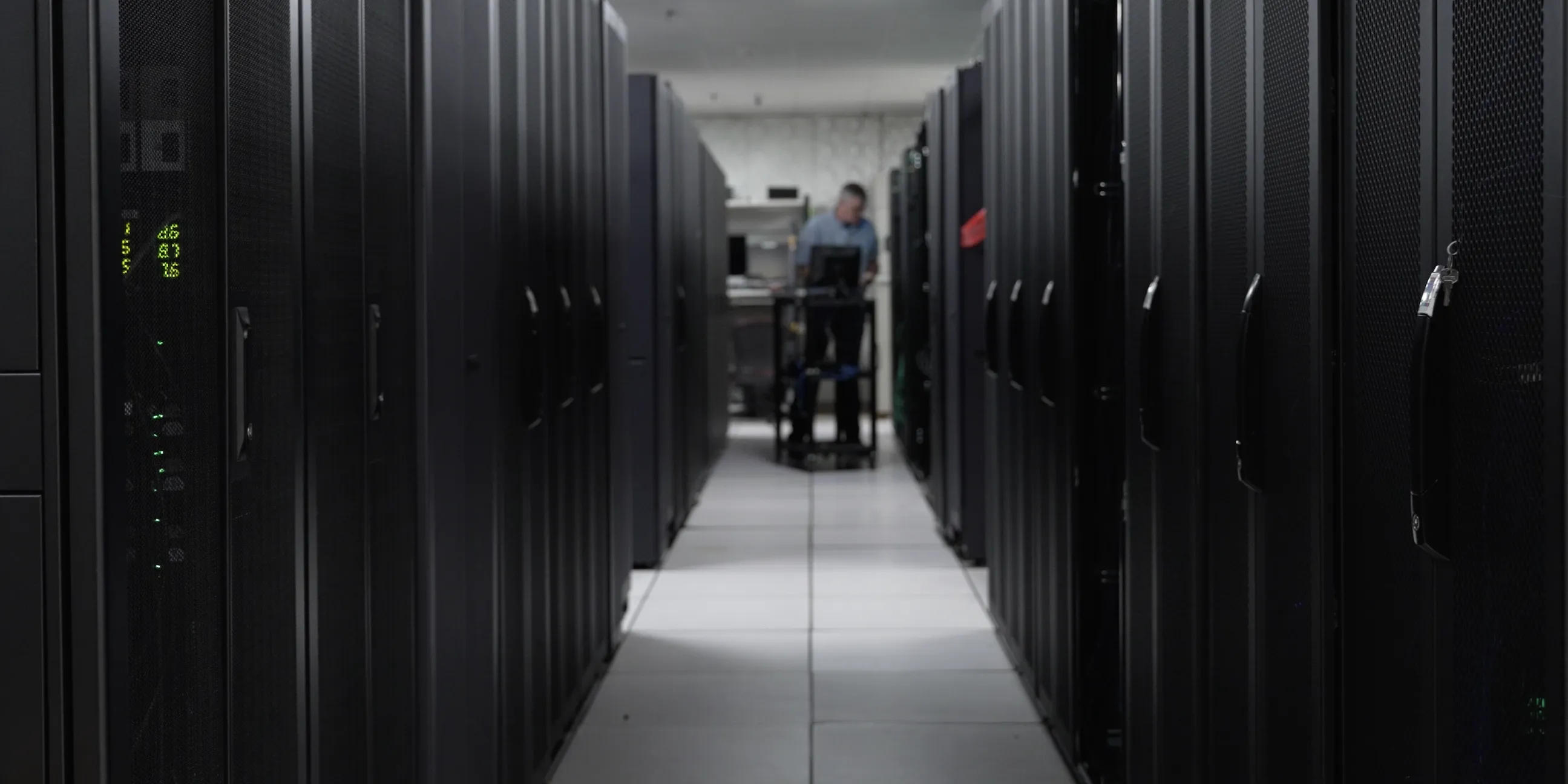
The University of Maryland Institute for Advanced Computer Studies (UMIACS) is investing more than $2.25 million to expand its computational infrastructure and strengthen support for artificial intelligence research across campus.
“Access to powerful computing is essential to the questions our faculty and students are exploring,” said David Jacobs, a professor of computer science and director of UMIACS. “These investments will help them pursue more ambitious research while allowing us to extend our computing resources and technical expertise to collaborators across campus.”
The funding includes a $500,000 award from the University of Maryland, which UMIACS will combine with $1,500,000 of its own fund balance money to upgrade Nexus, the institute’s shared computing infrastructure. Another $250,143 will go toward a dedicated high-performance GPU server for its Computational Linguistics and Information Processing (CLIP) Lab.
Rachel Rudinger, an associate professor of computer science, submitted the successful CLIP proposal. Its shared GPU server will strengthen the lab’s research capabilities.
Both proposals were approved by UMD’s Preserve, Pivot, and Grow (PPG) Program, following review by the senior vice president and provost, the vice president for research, and other senior campus administrators. The program supports strategic institutional capabilities, shared infrastructure and the sustainability of the university’s research enterprise.
The Nexus investment combines a faster, expandable network with an upgraded cooling architecture and more state-of-the-art GPU systems. It also provides new resources for localized AI model evaluation and research software development. Installation of the new equipment will begin in January and is scheduled to be completed by the end of June 2027.
Derek Yarnell, UMIACS’ director of computing facilities, expects this upgrade to sustain UMIACS research for future capabilities and growth in computing.
The cooling upgrades address a growing challenge as advanced computing systems generate more heat than traditional air cooling can effectively remove, explained Yarnell. His team is considering a liquid cooling system to address this issue, while actively exploring other potential solutions to find the best fit for the data center.
Network improvements will help move data between storage and computing systems and support communication among computing nodes. Currently the data center uses 100 Gigabit Ethernet (GbE), and the new upgrade will support 800 GbE. Together, these upgrades will enable larger experiments in fields like computer vision, natural language processing, scientific modeling, biological data analysis and more.
The expansion will also support UMIACS’ agreement to provide computing services for faculty affiliated with the Artificial Intelligence Interdisciplinary Institute at Maryland (AIM), along with proposed AI bootcamps and help centers.
Jacobs thanked Yarnell and his technical staff for their extensive work securing the awards, recognized Rudinger’s leadership, and credited support from UMIACS’ business and communications staff.
“These investments reflect the university’s confidence in our faculty, technical expertise and collaborative approach to research,” Jacobs said. “They will strengthen the resources our community depends on while extending UMIACS’ contributions to interdisciplinary research across Maryland. I look forward to seeing the discoveries and collaborations they make possible.”