CLIP Lab director Marine Carpuat explains how multilingual AI systems can facilitate cross-language communication.
The RQS senior investigator helped develop specially engineered photonic structures to guide light in stable and resilient ways.
Ruohan Gao is building systems that allow humans to hear, see and feel the world in a multisensory virtual space.
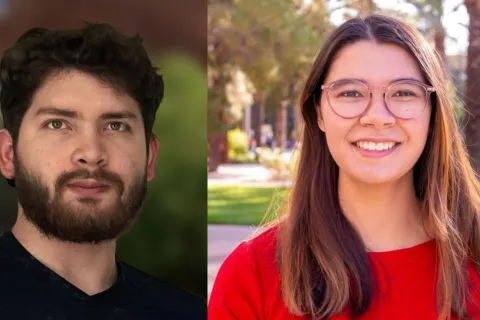
From different angles, Ph.D. students Iman Gholami, Arshia Soltani and Danny Mittal are training AI to master mathematical concepts.
QuICS fellow Nicole Yunger Halpern is helping organize a symposium that features a keynote address by science journalist Mark Alpert.
Ryan Blaustein of the UMD Center of Excellence in Microbiome Sciences is working with seven local urban farms to advance food safety.
A new generation of AI tools is changing how analysts and aid workers make sense of war in real time—if they can learn to trust what the models tell them.
The award supports her research into making battery-free devices more robust and reliable when operating on unpredictable energy.
She was recognized for transforming research and forensic case studies into engaging lessons that foster student reasoning.
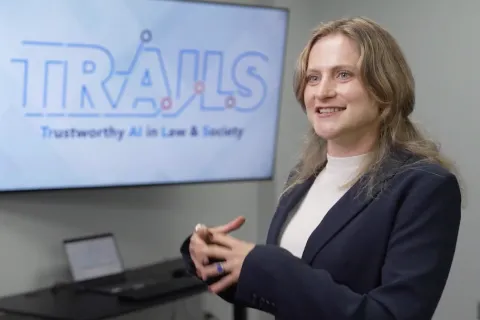
A study by TRAILS researchers warns that a chatbot’s polite demeanor creates a “charisma trap,” masking subtle biases and safety risks.