
1396 total results for “”



About Us
The University of Maryland Institute for Advanced Computer Studies (UMIACS)—pronounced YOU-me-acks—is a flagship multidisciplinary research institute where leading scientists harness the power of computation to tackle some of the most complex challenges facing science and society.
Established in 1984, UMIACS brings together more than 130 faculty members from 17 departments spanning eight University of Maryland colleges and schools. These researchers represent a wide range of fields, including computer science, engineering, linguistics, physics, biology and information science.
A hallmark of the institute is its collaborative, team-based approach to research. UMIACS faculty, postdoctoral researchers and graduate students advance knowledge in areas such as trustworthy AI, machine translation, autonomous robotics, microbiome science, quantum information science, robust quantum simulation, computer vision and cybersecurity.
UMIACS researchers secure more than $30 million annually in external funding, much of it from federal agencies and national laboratories across the Washington–Baltimore region. The institute is also home to 10 federal scientists advancing quantum information science and robust quantum simulation, and collaborates closely with physicians and clinicians at the University of Maryland School of Medicine to apply advanced computational techniques that accelerate biomedical research and improve health care.
To help train the next generation of researchers, UMIACS supports nearly 250 graduate students pursuing Ph.D.s across multiple disciplines and provides research opportunities for undergraduates through NSF-funded summer programs. The institute also provides administrative and technical support for interdisciplinary initiatives such as the Immersive Media Design (IMD) program and the Singh Sandbox makerspace, helping prepare future generations of innovators.
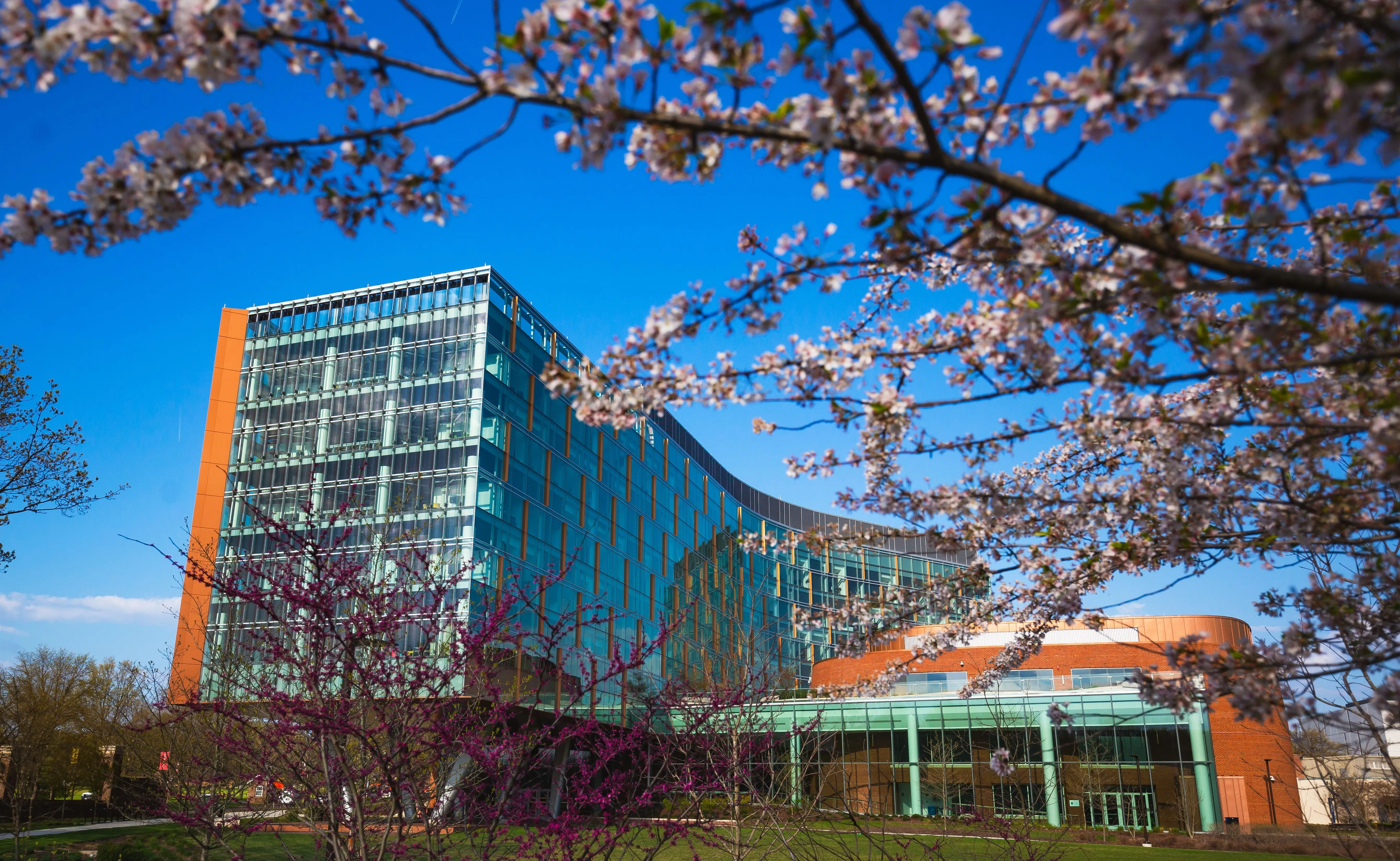
In 2019, most of our faculty, staff and graduate students moved into the Brendan Iribe Center for Computer Science and Engineering, a stunning 215,00 square foot facility that encourages innovation and collaboration. We also maintain a powerful data center and auxiliary office space in the nearby A.V. Williams Building (our former home). Faculty and students active in quantum information science have modern, renovated offices and meeting rooms in the Atlantic Building.
The success of UMIACS in catalyzing and excelling in interdisciplinary applications of computing is often attributed to:
- Identification and focus on grand challenge applications of computing with significant societal impact
- Identifying and incentivizing outstanding faculty to excel in their research through rotating appointments, and
- Mediating interaction amongst interdisciplinary researchers through an outstanding computational infrastructure. We have developed the skill set and culture necessary for building strong interdisciplinary research programs, providing advanced computing research infrastructure, and first-rate technical support, which have greatly facilitated our national and international leadership role in multi-disciplinary computing.
The synergistic environment provided by UMIACS is currently enabling innovative collaborations between faculty from:
We also have numerous affiliate and adjunct faculty from Physics, Chemistry and Biochemistry, Philosophy, Entomology, Atmospheric & Oceanic Science, Mathematics, Mechanical Engineering, and the School of Music, as well as a dozen federal scientists embedded full-time on the UMD campus working in areas related to quantum computing.
Who is UMIACS?
UMIACS is comprised of many talented individuals that fall largely into one of the categories listed below. Except for graduate students and affiliate or adjunct members, an individual is a member of UMIACS if they have a payroll appointment in the institute, i.e., if at least part of their salary is paid through the institute.
Business office, technology, and communication staff provide the core services offered to our community.
UMIACS faculty serve as mentors to many graduate students. These students are initially admitted to the campus through one of the graduate programs to which our faculty belong, then join the institute when they join the labs of our faculty. Students with a payroll appointment in UMIACS are paid at UMIACS graduate stipend rates.
Professional track (PTK) faculty is a University of Maryland term/category for faculty who are not eligible for tenure. In UMIACS, such faculty are mostly engaged in research activities, are appointed on a contractual basis, and largely supported through external funding. Professional track faculty appointments are governed by the UMIACS Appointment, Evaluation, and Promotion (APT) policy for professional track faculty.
According to the University of Maryland policies, postdoctoral researchers are classified as professional track faculty (see above). Unlike other professional track titles, postdoctoral appointments are temporary. An individual may hold this title for a maximum of 6 years, and new hires must have completed their Ph.D. within five years of the start of their appointment.
Tenured or tenure-track faculty members who have a payroll appointment in the institute represent the core faculty of the institute and are responsible for staffing the committees that govern our operations, and for leading the scientific activities of the institute. UMIACS is not a tenure-granting unit, thus all core tenure-track faculty have joint appointments in other departments on campus. All joint appointments in the institute are made on a rotating basis and are reviewed by the UMIACS Appointments, Promotion, and Tenure (APT) committee. Appointments at the assistant and associate professor levels are typically renewed every 3 years, while appointments at the full professor level are typically renewed every 5 years.
Faculty from outside the University of Maryland (adjunct) as well as campus faculty with no-cost appointments in the institute (affiliate) may have an affiliation with the institute to create stronger ties with our faculty. Generally, such affiliations do not make any UMIACS resources available to these affiliate and adjunct faculty other than including them in institute-wide communications. Resources may be provided to affiliate and adjunct faculty only in the context of externally funded research projects that are led by UMIACS faculty and that are routed through the UMIACS business office.


Director's Message to UMIACS June/July 2026
 As you may have already heard, the College of Computer, Mathematical, and Natural Sciences has announced a new director of UMIACS—David Jacobs—who will assume the role this September. I will continue to serve as interim director over the next two months.
David is an outstanding choice for this position, bringing a distinguished record of research and scholarship along with a compelling vision for the institute's future. He will lead an organization that is a powerhouse at the University of Maryland and an internationally recognized hub for interdisciplinary computing research.
Serving as interim director for the past 12 months has been a rewarding experience. Although I have been an active member of UMIACS since arriving at Maryland in late 2014, this role has given me an even deeper appreciation for the people and operations that make the institute so successful.
Despite recent budget reductions across campus—including cuts to the UMIACS base budget—the institute remains strong. That resilience is due in large part to the outstanding work of our business and technical staff, whose expertise and dedication are essential to everything we do.
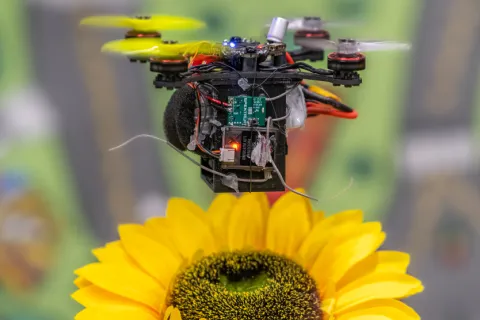
Our research enterprise also continues to thrive. Several examples are featured in this month's newsletter, including a collaboration between UMIACS researchers and the Max Planck Institute for Software Systems to develop a surgical rollback tool for AI memory. Other groundbreaking work in computer vision and robotics demonstrates the breadth and impact of the research taking place across the institute.
UMIACS-affiliated faculty will also play a significant role in the latest round of Grand Challenges Grants, contributing to interdisciplinary projects addressing pandemics, cancer, infectious diseases, and environmental health.
What has consistently driven the success of UMIACS is its people. The institute brings together an extraordinarily talented community, and the achievements highlighted in this newsletter offer a glimpse of the excellence that defines UMIACS.
Among those recognized this month is Leila De Floriani, a professor of geographical sciences and longtime UMIACS member, who was named a Distinguished University Professor. The honor recognizes her internationally acclaimed research, leadership, and commitment to teaching, as well as her pioneering contributions to geospatial computing, data science, and scientific visualization.
Also recognized was Mohammad Hajiaghayi, who received the Association for Computing Machinery's Special Interest Group on Economics and Computation (ACM SIGecom) Test of Time Award. The award recognizes research that has had a lasting impact on the study of online auctions, mechanism design, and digital markets.
These are just two examples of the excellence that defines UMIACS. Every day, our faculty, staff, graduate students, and postdoctoral researchers push the boundaries of knowledge, develop innovative solutions, and expand the reach of Maryland research. Their work strengthens the institute and creates new opportunities for discovery across disciplines.
It has been an honor and a privilege to serve alongside all of you during the past year. I look forward to continuing to contribute to the success of UMIACS and to supporting the institute's mission in the years ahead.
Best,
Andrew Childs
Interim Director, UMIACS