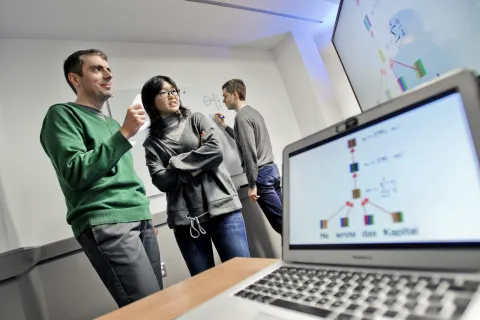
In a paper being presented this week, authors affiliated with the CLIP Lab argue that topic model developers should reassess the increasing use of machine learning to evaluate their work.
Dominik Hangleiter, one of the newest Hartree Postdoctoral Fellows, develops theoretical frameworks to identify problems where quantum computers can be proven to dominate.
Being conferred Fellow status is the highest grade of IEEE membership, and one that is recognized by the technical community as a prestigious honor and an important career achievement.
Metzler’s three-year project seeks to develop artificial intelligence-based multimodal sensor fusion algorithms that are fully self-supervised and do not require training data.
Eight UMIACS faculty will participate in the workshop, offering expertise and knowledge in a team-based setting that provides a positive intellectual, social and emotional environment.
The system will have the capability to significantly improve upon the sound available to aviators in aircrafts to increase their situational awareness, reduce listener fatigue and improve reaction time.
The program, now in its third year, aims to support machine learning researchers from underrepresented groups as they pursue new scientific discoveries and academic opportunities.
A team of researchers in the Computational Linguistics and Information Processing (CLIP) Laboratory are using computational modeling to investigate learning mechanisms that can help listeners adapt their speech perception of a new language.