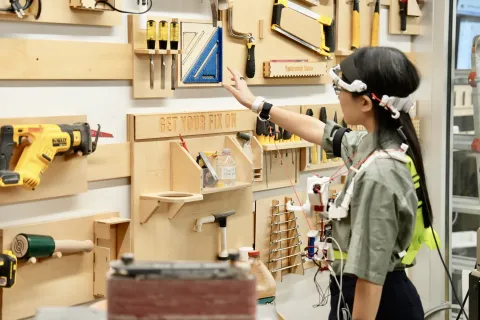
UMD researchers developed an AI exosuit that intercepts human errors mid-motion to accelerate physical skill learning.
Hernisa Kacorri and Hal Daumé III discovered that AI apps for blind users often give long, cluttered descriptions instead of direct answers.
Suho Shin and Zeyu Yan were honored for their research on algorithmic AI delegation and sustainable electronic design.
Over two decades later, the Gordon-Loeb Model remains a vital framework for managing cyber risk while expanding into AI and quantitative research.
By combining camera images and recorded taps, UMD researchers aim to give 3D objects realistic sounds for applications in virtual reality, gaming and more.
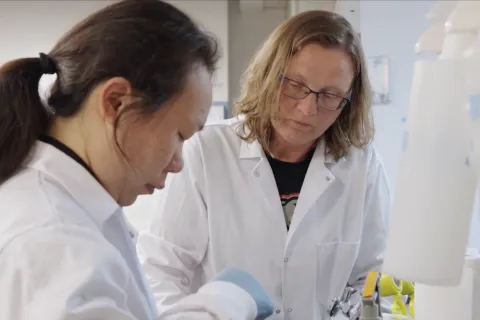
Birthe Kjellerup's research seeks to solve problems caused by bacteria and biofilms, while using these same biofilms to address other challenges.
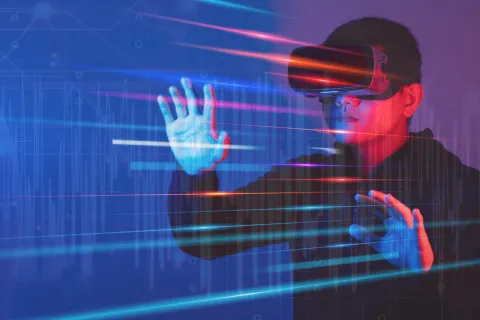
Findings from a real-time brain wave study could help VR and AR designers detect and reduce dizziness, nausea and other symptoms.
Their study shows how collective movement enables viruses to persist with migrating bacterial colonies while minimizing risk.
A new algorithm developed by UMD researchers builds the digital maps that power AI search at record-breaking speeds.
Soheil Feizi is part of a $7.5M multi-institutional initiative to advance the next generation of artificial intelligence.