
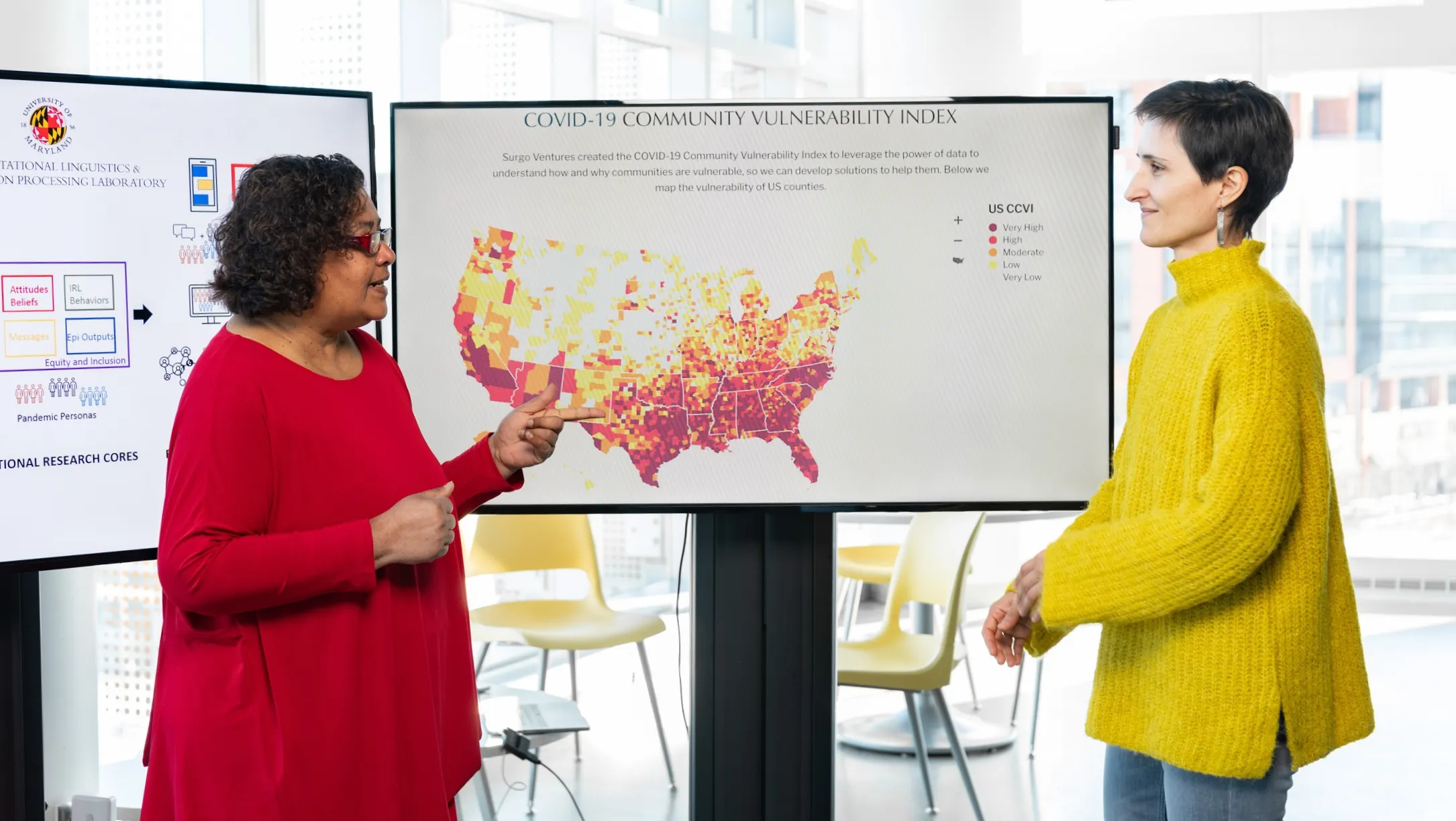
University of Maryland researchers are examining how geography shapes public health conversations on social media. They describe their study as the first to examine both the relationship between geographic co-location and engagement, and the content characteristics of those conversations.
Most notably, their findings show that engagement is significantly higher when users are in the same U.S. state as the public health expert sharing the message. Replies from those users were also more positive when experts shared personal experiences or feelings.
The research was supported by a $1 million National Science Foundation grant awarded in 2022 to improve messaging and modeling during pandemics.
“During the pandemic, we saw firsthand how the same public health message could resonate very differently across communities,” said Neil Jay Sehgal, the Wegmiller Professor of Healthcare Administration at the University of Minnesota, a former assistant professor in the UMD School of Public Health and co-PI of the NSF award. “What this research adds is evidence that geographic connections and personal experiences are associated with how people engage with experts online.”
The COVID-19 pandemic presented a complex communication challenge: public health experts had to provide vital guidance amid rapidly evolving science and a flood of misinformation and disinformation on social media.
Using a Poisson regression model, statistical tests and a large language model, the researchers analyzed Twitter conversations about COVID-19 from January 2020 to November 2021. Their dataset included more than 19,000 tweets from nearly 500 public health experts and approximately 800,000 replies.
The researchers concluded that effective public health communication involves more than simply delivering accurate information. It also involves making that information relevant and meaningful to the communities receiving it.
“We learned early on that ‘one size fits all’ rarely fits all. People need to understand not only what the science says, but also why it matters for their own communities and circumstances,” explained Sehgal. “This study helps explain why those connections matter: geographic proximity and shared personal experiences can shape how people engage with public health experts. For public health communicators, the takeaway is that scientific credibility and local relevance need to go hand in hand.”
The study summarizing the findings was co-authored by UMD Computational Linguistic and Information Processing (CLIP) Lab members Paiheng Xu, a computer science Ph.D. candidate; Louiqa Raschid, a professor in the Robert H. Smith School of Business; and Vanessa Frias-Martinez, a professor in the College of Information. Both Raschid and Frias-Martinez were co-PIs on the original NSF award, and have appointments in the University of Maryland Institute for Advanced Computer Studies (UMIACS), which provided administrative and technical support for the work. The study was presented last spring at the 20th International AAAI Conference on Web and Social Media in Los Angeles.
—Story by Maria Herd, UMIACS communications group