
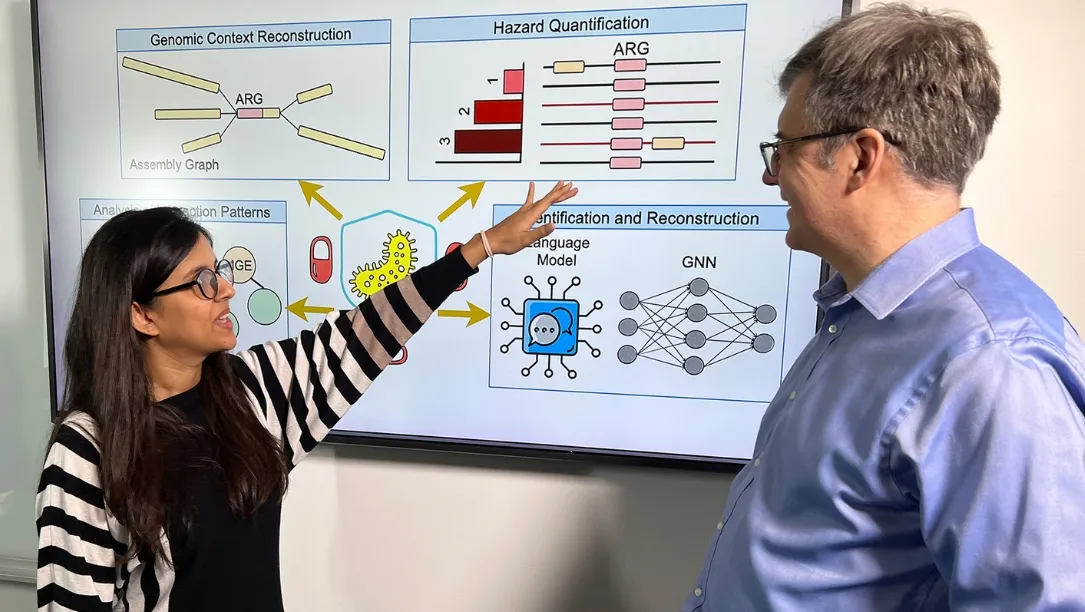
From human health to environmental sustainability, microscopic communities play a critical role in shaping the world around us. But understanding these complex ecosystems remains a major scientific challenge. At the University of Maryland, bioinformatics engineer Nazifa Ahmed Moumi is working to bridge that gap by developing faster, more accessible tools to analyze vast amounts of genetic data.
Moumi’s research focuses on metagenomics, the study of genetic material collected directly from environmental samples. Unlike traditional approaches that examine a single organism in isolation, metagenomics captures the full diversity of microbial life in each environment. While this approach has opened the door to answering previously unapproachable scientific questions, it also produces dense and highly complex datasets that are difficult to interpret.
“As much as metagenomics has advanced our understanding, there are still a lot of unknowns,” says Moumi, who is based in the University of Maryland Institute for Advanced Computer Studies (UMIACS). “Real biology and real data are still very complex.”
Working with MPower Professor of Computer Science Mihai Pop, who also is in UMIACS, Moumi is contributing to two National Institutes of Health–funded microbiome projects aimed at reconstructing genomes directly from environmental samples. Her work centers on designing computational pipelines and algorithms that transform raw biological data into meaningful insights for researchers across disciplines.
In one project, Moumi is upgrading an existing metagenomic assembly tool to improve its efficiency and scalability. By introducing parallelization—a method that enables independent computational steps to run simultaneously—she is eliminating major processing bottlenecks. The result is a significantly faster tool that can better handle the massive datasets generated in metagenomic research.
A second project focuses on improving how genomes are reconstructed from sequencing data. Moumi is working with long genetic sequences derived from environmental samples and combining them with shorter DNA fragments, or “reads,” to build structural graphs.
These graphs allow researchers to piece together complete genomes while also identifying subtle variations between closely related microbial strains. Such distinctions are critical, for example, in determining whether one strain carries genes for antimicrobial resistance while another does not.
Moumi’s journey into bioinformatics began during her undergraduate studies in computer science at the Bangladesh University of Engineering and Technology. Early on, she recognized an opportunity to apply computational methods to real-world problems in biology and human health.
“Seeing the algorithms or the pipelines that I developed actually being used for real biological data and deriving informed insights from them was a really rewarding experience,” she said.
She went on to earn her Ph.D. in computer science at Virginia Tech, where her research focused on metagenomics, microbiomes and antimicrobial resistance. During that time, she frequently relied on computational tools developed by Pop’s lab—an experience that ultimately influenced her decision to join his research group at Maryland.
“Mihai is a very prominent name in the field of metagenomics,” Moumi said. “I feel very lucky that I get to work with him and learn from him every day. Whenever I’m trying to decide something, he’s the go-to person to help untangle the challenges I’m having.”
Looking ahead, Moumi plans to continue working at the intersection of computation and biology, focusing on the engineering side of scientific discovery. By building robust, scalable software pipelines, she aims to support biologists, microbiologists and environmental scientists working with increasingly complex datasets.
—Story by Diya Sharma, UMIACS communications group