
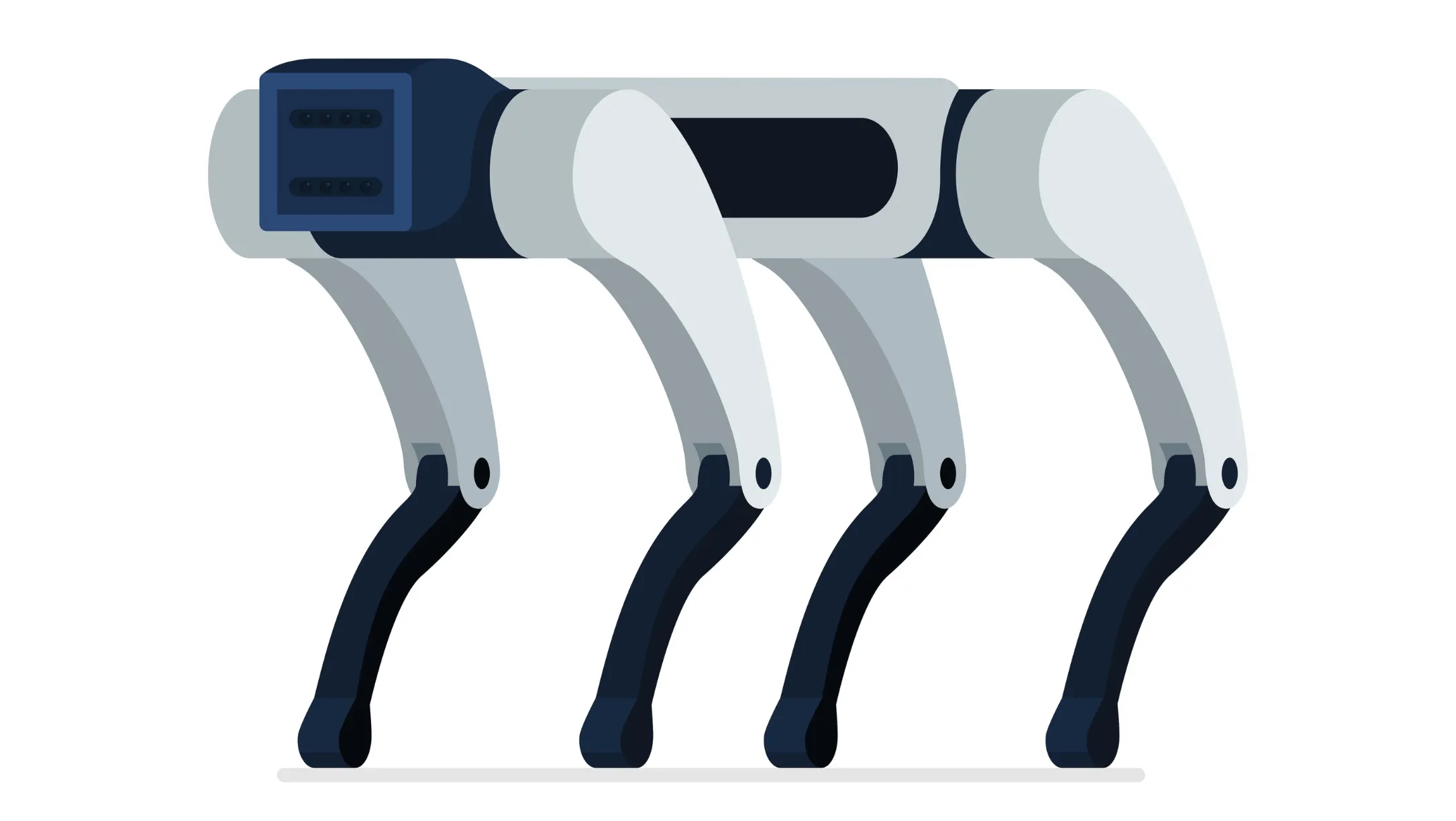
A four-legged robot can learn to run and recover from a shove through reinforcement learning, a form of artificial intelligence in which a system learns through trial and error by receiving rewards for useful behavior. But transfer that robot’s control system into a body with a different weight, shape or set of motors, and those skills can fall apart.
University of Maryland and George Mason University researchers have developed a more efficient approach. Their framework, the Morphology-aware FiLM Critic (MorFiC), trains a locomotion policy on one robot design and applies it to others without retraining. A paper describing the work has been accepted to the 2026 Conference on Robot Learning (CoRL 2026) in Austin, Texas.
“Our approach trains on a single robot in about two hours,” said the study’s lead author, Prakhar Mishra, who earned a Master of Engineering in Systems Engineering at UMD with a specialization in robotics. Comparable approaches can require tens or hundreds of hours because they train on many robot designs or use much larger models, he said.
Mishra led the project’s conceptual development, methodology, implementation, experimental design and analysis. George Mason computer science doctoral student Amir Hossain Raj contributed to the experimental implementation, robot deployment and evaluation. UMD’s Dinesh Manocha and George Mason’s Xuesu Xiao supervised the work and provided technical guidance and manuscript review.
Manocha is a Distinguished University Professor of Computer Science with an appointment in the University of Maryland Institute for Advanced Computer Studies (UMIACS) and served as Mishra’s adviser. Xiao, an assistant professor of computer science, is Raj’s adviser.
Much of the UMD research took place in Manocha’s Geometric Algorithms for Modeling, Motion and Animation (GAMMA) Lab.
The researchers trained MorFiC on a single quadruped—a four-legged robot—rather than a collection of robot bodies, then tested the same policy on seven platforms. This “zero-shot” transfer required each machine to use what the system had already learned, without further training or adjustments.
Differences in mass, leg geometry, joint limits and motor strength change how a robot responds to commands. A policy—the learned rules translating sensor readings into actions—may work smoothly on its original robot but become unstable on another.
MorFiC focuses on the part of reinforcement learning that evaluates those actions. In an actor-critic system, the “actor” decides what the robot should do, while the “critic” estimates how useful that action will be and guides the actor’s learning.
The researchers found that the critic can become poorly calibrated when working across different robot bodies. The same pose or action may produce different results depending on the machine, yet a conventional critic may average those outcomes and steer learning in the wrong direction. MorFiC instead supplies the critic with information such as the robot’s mass and joint limits, allowing it to judge an action in the context of the body performing it.
In simulations, MorFiC produced the highest forward speed among the tested approaches on five of seven platforms. On an AlienGo robot, it reached 1.98 meters per second, while conventional reinforcement-learning variants remained below 0.65 meters per second. AlienGo differed substantially from the Unitree Go2 design used for training.
The researchers evaluated speed alongside “survival,” or whether a robot remained upright for the full test. Survival alone can be misleading: A robot may avoid falling yet make little or no forward progress. The team therefore looked for stable operation paired with a usable gait.
The team also deployed the same policy on real Unitree Go1 and Go2 robots without fine-tuning. Across 10 trials, the Go1 moved indoors and outdoors at about 1.4 to 1.7 meters per second and completed more than 80% of its runs without freezing or suffering a gait failure. It also recovered from pushes. The Go2 reached about 1.1 to 1.3 meters per second.
Hardware tests exposed practical challenges, including control delays, errors in estimating movement, slipping feet and uneven steps. The Go2 also moved more slowly and failed more often under the team’s current deployment setup.
MorFiC has broader limits as well. Transfer depended heavily on how physically similar the target robot was to the training model. The Go2-trained policy worked well on nearby designs such as the Go1, A1 and Cheetah but failed to produce effective movement on the heavier B1 and the more physically dissimilar ANYmal. Simply broadening the range of physical properties during training made the policy more cautious rather than solving the problem.
The researchers suggest training MorFiC on a small number of source robots as a next step—more than one, but far fewer than methods that train across large collections of robot designs. Their current work covers only quadrupeds; extending the framework to two-legged robots and humanoids remains an open challenge.
Watch a video of the robots being tested.
—Story by UMIACS communications group