
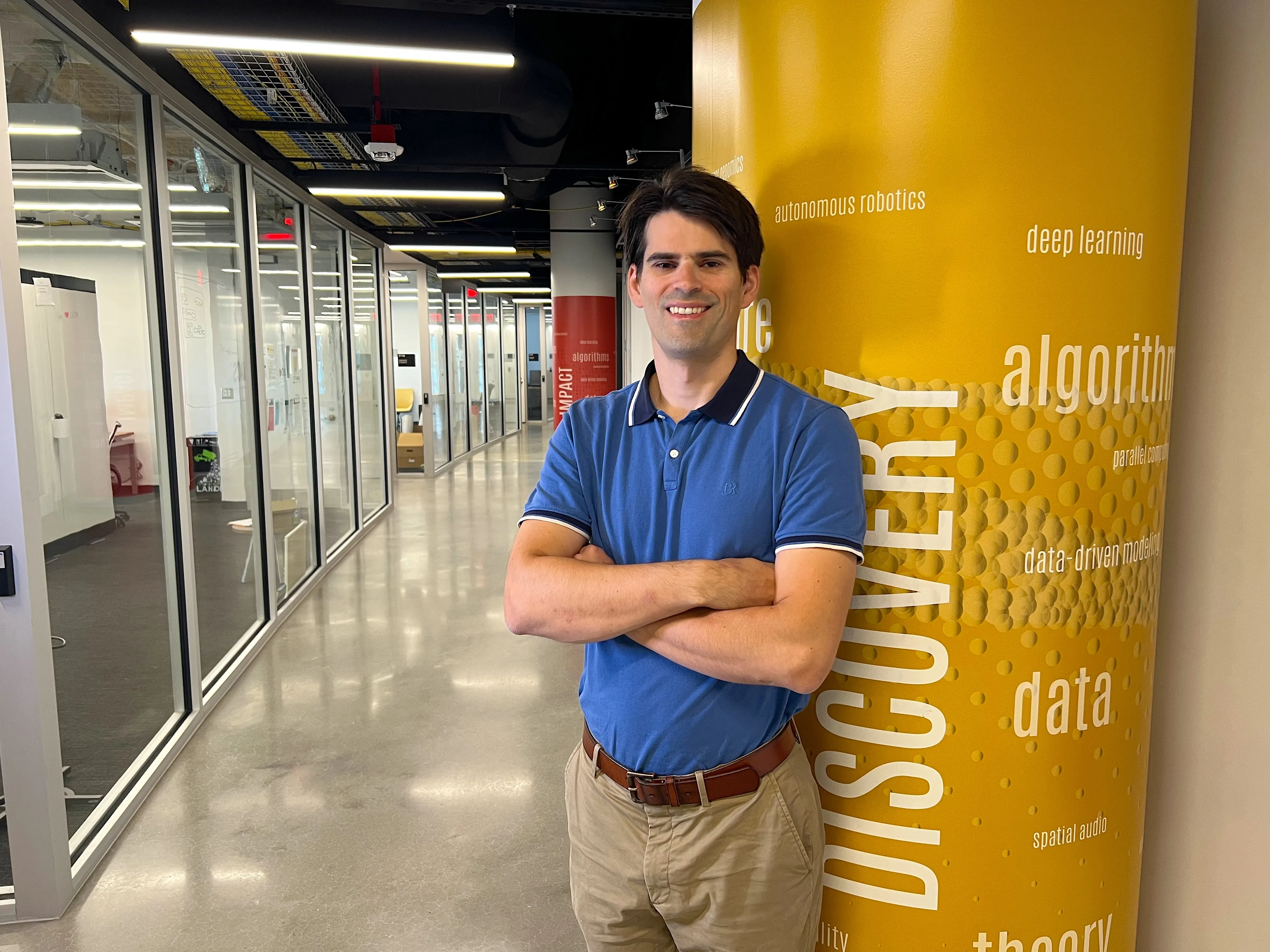
Michael Gullans has spent years confronting one of quantum computing’s most stubborn problems: how to protect extraordinarily fragile quantum information from the noise and errors that can derail a calculation.
Now Gullans, a National Institute of Standards and Technology (NIST) physicist based at the University of Maryland, has been selected to receive the 2026 Arthur S. Flemming Award—one of the nation’s most prestigious honors for federal employees—for theoretical breakthroughs that could help make practical quantum computers possible.
At UMD, Gullans is a Fellow in the Joint Center for Quantum Information and Computer Science (QuICS), deputy director and associate director for research at the NSF Quantum Leap Challenge Institute for Robust Quantum Simulation (NSF RQS), and an adjunct assistant professor in the University of Maryland Institute for Advanced Computer Studies (UMIACS).
He is one of seven federal employees chosen for the 77th annual Flemming Awards and will be recognized in the Basic Science category during a Nov. 8 ceremony at the National Academy of Sciences in Washington, D.C.
“It’s definitely an honor,” Gullans said. “The award recognizes my contributions, but also the broader progress in the field.”
He said the recognition also reflects the work of his collaborators, graduate students and postdoctoral researchers.
Established in 1948, the Flemming Awards recognize federal employees with three to 15 years of government service whose accomplishments span fields including science, applied engineering and law. More than 700 people have received the award, including astronaut Neil Armstrong, physician and scientist Francis Collins who led the National Institutes of Health from 2009–2021, and former Secretary of Defense Robert Gates.
Gullans’ research addresses a fundamental obstacle in quantum information science: today’s quantum processors are noisy. Their quantum bits, or qubits, are so sensitive that heat, stray signals and other environmental disturbances can introduce errors before a calculation is complete.
He has developed theories to predict and manage those behaviors, demonstrated new quantum phenomena on working hardware and advanced quantum error-correction techniques designed to detect and repair mistakes without destroying the information stored in a quantum system.
That work is essential to the development of fault-tolerant quantum computers—machines capable of continuing to operate accurately even when individual components experience errors. Researchers hope such systems will eventually tackle problems beyond the reach of conventional computers in areas such as drug discovery, materials design, cryptography and logistics.
“All practical quantum computers will be based around fault-tolerant techniques,” Gullans said.
Without effective ways to shield quantum systems from their surroundings, he explained, they lose the properties that give them their potential computational advantage. Developing fault-tolerant methods therefore lays the groundwork for future quantum technologies.
The research cited by the Flemming Award includes advances Gullans and his collaborators reported in 2024 using neutral-atom quantum processors. That work involved researchers from Harvard University, MIT and the quantum computing company QuEra. His broader research spans several hardware platforms, including trapped ions and solid-state systems studied in collaboration with Duke University, IonQ and Quantinuum.
Garnett Bryant, Gullans’ supervisor and leader of the Atom Scale Device Group in NIST’s Nanoscale Device Characterization Division, said Gullans’ theoretical work helps bridge the divide between experimental quantum hardware and useful computation.
“Michael is one of the world’s leaders in studying error mitigation in quantum computers and developing the tools and understanding needed to implement that” in the noisy quantum systems available today, Bryant said.
The full impact of that work may become clearer as early quantum computers grow more capable, he added. By identifying general principles that explain how errors emerge and spread, Gullans has made it easier for researchers to develop and apply methods for correcting them.
Bryant also pointed to the breadth of Gullans’ accomplishments over the past several years, as well as his ability to lead multiple projects simultaneously.
“His enthusiasm and ability to drive multiple projects forward make him an extraordinarily productive person for us,” Bryant said.
Gullans credits the close relationship between NIST and UMD with helping accelerate his research. Since arriving at UMD in 2020, he has worked with QuICS faculty members including Co-Director Daniel Gottesman and Fellow Victor Albert to advance quantum theory, educate graduate students and mentor emerging researchers.
The partnership also gives Gullans the freedom to pursue exploratory basic research that may not produce an immediate commercial application but can transform a field over time.
For Gullans, receiving an award rooted in federal service underscores the public purpose of that work.
“Science fundamentally is a public service,” he said. “I’m very grateful to live in a society where these things are supported through the government and through research so that I could pursue this career.”
Although quantum computing could eventually deliver significant economic benefits, Gullans said much of his career has focused on fundamental scientific questions without an obvious short-term payoff.
“It is done in the service of the public,” he said, “and I’m trying to make sure that my work does ultimately benefit the wider community.”
—Story by Diya Sharma, UMIACS communications group