She will focus her research on developing AI models that protect billions of users from malicious activities such as malware, phishing and other cyber scams.
She has received substantial financial support in the form of a fellowship and scholarship for her groundbreaking work to measure censorship in smaller countries with repressive regimes and limited internet access.
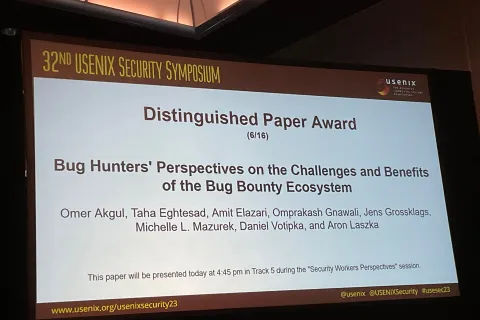
Their award-winning paper delves into the challenges faced by bug bounty hunters—ethical hackers who discover and report vulnerabilities or bugs to a platform’s developer.
Their two-year study found that 27% of the phones they successfully bid on contained personal data like Social Security numbers, credit card and banking information, passport data, pictures of driver’s licenses, and more.

Kevin Bock was recognized for developing Geneva, a novel algorithm that automatically discovers how to manipulate packet streams to evade digital censors.
The MC2 papers at IEEE S&P cover timely topics that have important real-world implications for improving security and privacy in a wide range of contexts.
Jonathan Katz, Dana Dachman-Soled and Gorjan Alagic are developing a framework for cryptographic systems that can weather increasingly powerful quantum computers.
It will support Maryland Cybersecurity Center students and postdocs traveling to academic conferences, workshops or other research events focused on cybersecurity or privacy.