
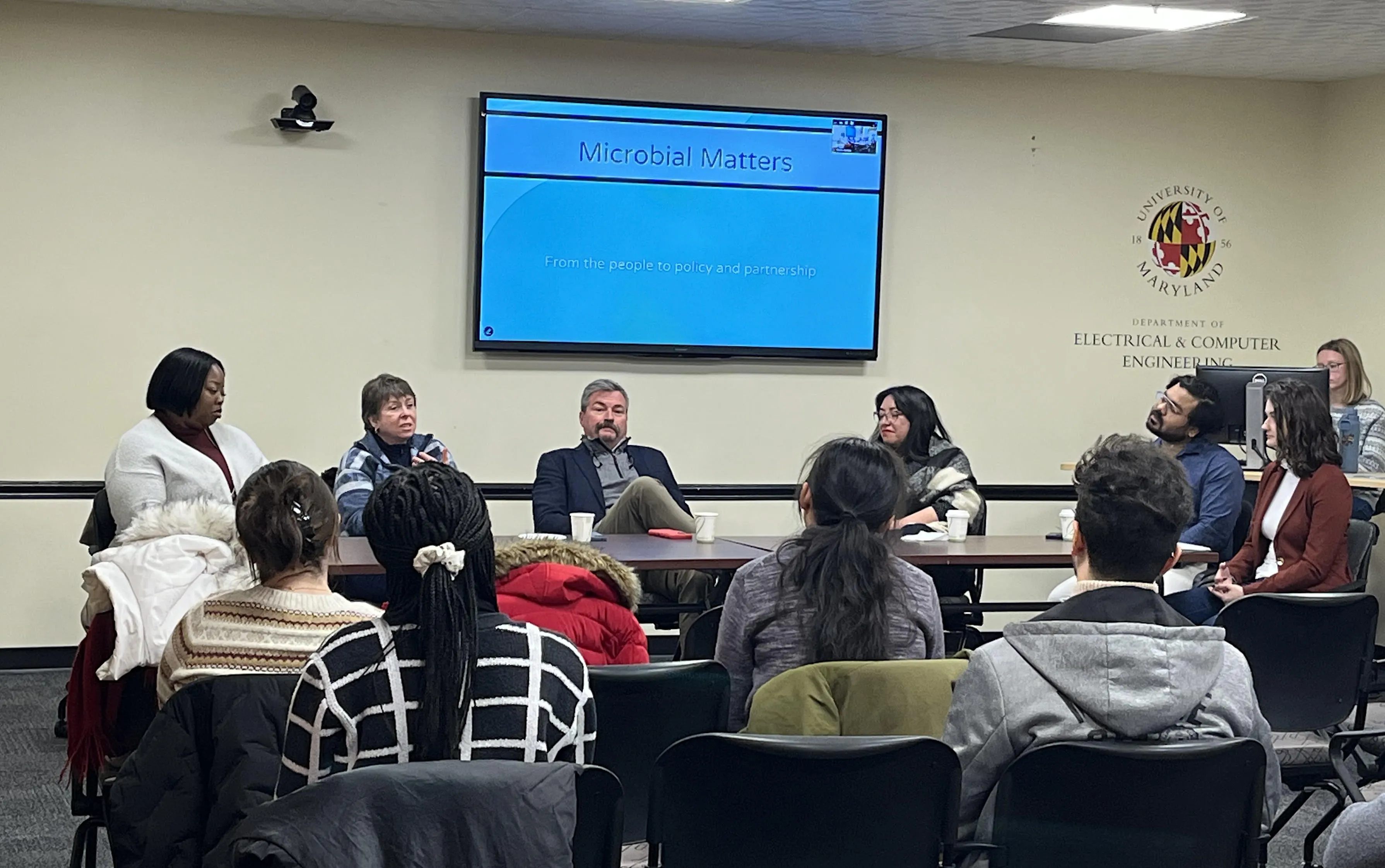
Eight graduate students at the University of Maryland wrapped up the Microbiome Center Fellowship with a student-led panel examining a pressing question in the field: How can microbiome science move beyond discovery to make a meaningful impact on public health?
The event, “Microbial Matters: Translating Microbiome Science to Maximize Impact in Public Health,” marked the culmination of the seven-month interdisciplinary program. The fellowship brings together researchers studying human, environmental and agricultural microbiomes, encouraging collaboration across disciplines that rarely intersect.
Coordinated by the UMD Center of Excellence in Microbiome Sciences, the fellowship is designed to help emerging researchers approach microbial systems through a shared, systems-level lens—while also building skills in teamwork, communication and real-world translation.
“We’re excited to see how these students take what they’ve learned and shape the future of microbiome science,” says Gabi Steinbach, associate research scientist and program coordinator of the center.
Throughout the program, fellows participated in team science training, workshops and seminars. They also received stipends and access to shared computational and sequencing resources, including those at the University of Maryland Institute for Advanced Computer Studies. Planning and hosting the capstone panel allowed students to apply those lessons in a public-facing setting.
The fellows themselves drove the discussion, crafting questions that reflected both the promise and the persistent challenges of applying microbiome research outside the lab.
“As fellows, we wanted to explore effective strategies for translating microbiome research into actionable insights that advance public health and societal progress,” says Darby Steinman, a fourth-year doctoral student in bioengineering. “Our goal was to foster an open, interactive dialogue among experts across diverse sectors of the health sciences.”
Yue Jiang, a third-year doctoral student in nutrition and food sciences, says the panel tackled a widening gap between rapid scientific discovery and practical application. While microbiome research is expanding quickly, she notes, turning findings into prevention strategies, policy guidance and clinical tools remains difficult.
To address that divide, the students assembled a panel of experts whose work connects research with communities, policy and industry.
Yolanda Savoy of Coppin State University emphasized the importance of communicating complex science clearly and engaging underserved populations. Biotechnology researcher Scott Jackson—whose experience includes roles at the U.S. Food and Drug Administration and the National Institute of Standards and Technology—shared insights on technology translation and the future of personalized medicine.
Cynthia Baur, director of the Horowitz Center for Health Literacy at the University of Maryland School of Public Health, discussed applying research across public health, environmental and occupational contexts. Magaly Toro of UMD’s Center of Excellence in Microbiome Sciences highlighted strategies for conveying complex scientific ideas to diverse audiences.
For many fellows, the conversation reinforced that discovery alone is not enough. Steinman recalls Savoy stressing the importance of presenting research accessibly and meeting communities where they are.
Ingrid Roselyne Dukundane, a fourth-year doctoral student in the A. James Clark School of Engineering, and Raunak Dey, a fourth-year doctoral student in physics, say the panel underscored researchers’ responsibility to center diverse perspectives and treat communication as a core scientific skill.
Other fellows pointed to personal shifts in how they define research success. Erin Harrelson, a second-year doctoral student in nutrition and food sciences, says the program reinforced the importance of translating research into usable information.
Yuzhu Mao, a fifth-year doctoral student in environmental engineering, says the experience broadened her view of impact to include both rigorous science and clear communication. Jiang adds that the fellowship prompted her to think more intentionally about collaboration—and about who ultimately benefits from academic research.
The program’s emphasis on interdisciplinary teamwork is already influencing fellows’ next steps. Nakia Fallen, a second-year doctoral student in molecular and cellular biology, says organizing the panel demonstrated how complex, systems-level challenges can be tackled collaboratively.
Claire Barlow, a second-year doctoral student in environmental health sciences, reports finding new mentorship opportunities through the program, while Mao and Fallen have begun pursuing cross-field collaborations rooted in shared scientific questions.
Program coordinator Steinbach says that by closing the fellowship with a public conversation on translating microbiome science into real-world impact, the fellows demonstrated the kind of cross-disciplinary thinking the program aims to cultivate—and the role early-career researchers may play in shaping the future of microbiome science.
—Story by Melissa Brachfeld, UMIACS communications group