
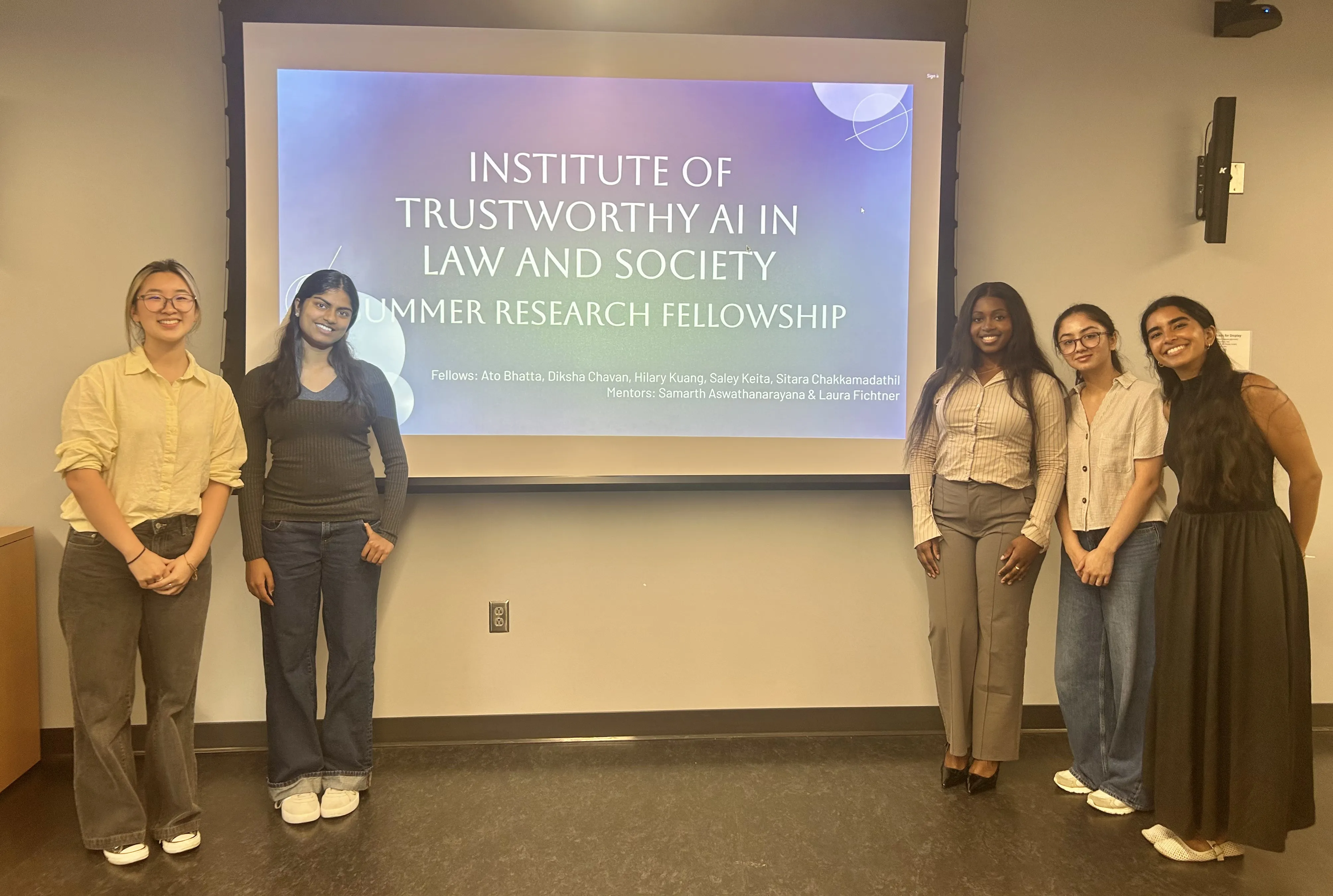
As artificial intelligence increasingly shapes health care, education and employment, concerns about potential harms are straining public trust in the technology. This past summer, an interdisciplinary team of undergraduate students spent 10 weeks developing an exploratory, locally run prototype that helps researchers identify and address how their work fits into the dynamics of trust and trustworthiness in AI.
The Trustworthy AI Network Tool was the culmination of the 2026 Summer Undergraduate Research Fellowships (SURF) at the Institute for Trustworthy AI in Law and Society (TRAILS), which engages an interdisciplinary team of undergraduates in hands-on research. Guided by University of Maryland mentors Samarth Ashwathanarayana and Laura Fichtner, fellows Ato Bhatta, Diksha Chavan, Hilary Kuang, Saley Keita and Sitara Chakkamadathil explored how AI researchers can more consistently incorporate fairness, transparency and accountability into their work.
“Without trust in research, people don’t really know what to make of the work of super talented researchers who work really hard on what they do,” said Chakkamadathil, a UMD computer science major. “And we argue that without having that foundation of trust, researchers can’t do what they’re supposed to.”
The team based its platform on “A Trust Map for TAI Research Practices,” a framework developed by Fichtner and Katie Shilton, a professor in the College of Information and co-principal investigator of TRAILS. The tool prompts AI researchers to reflect on and articulate their assumptions about how trustworthiness for AI systems is defined and designed in the context of their work. It then generates a map that visualizes the trust relationships that characterize a trustworthy AI effort and traces the practices used to interrogate and establish trustworthiness within the project.
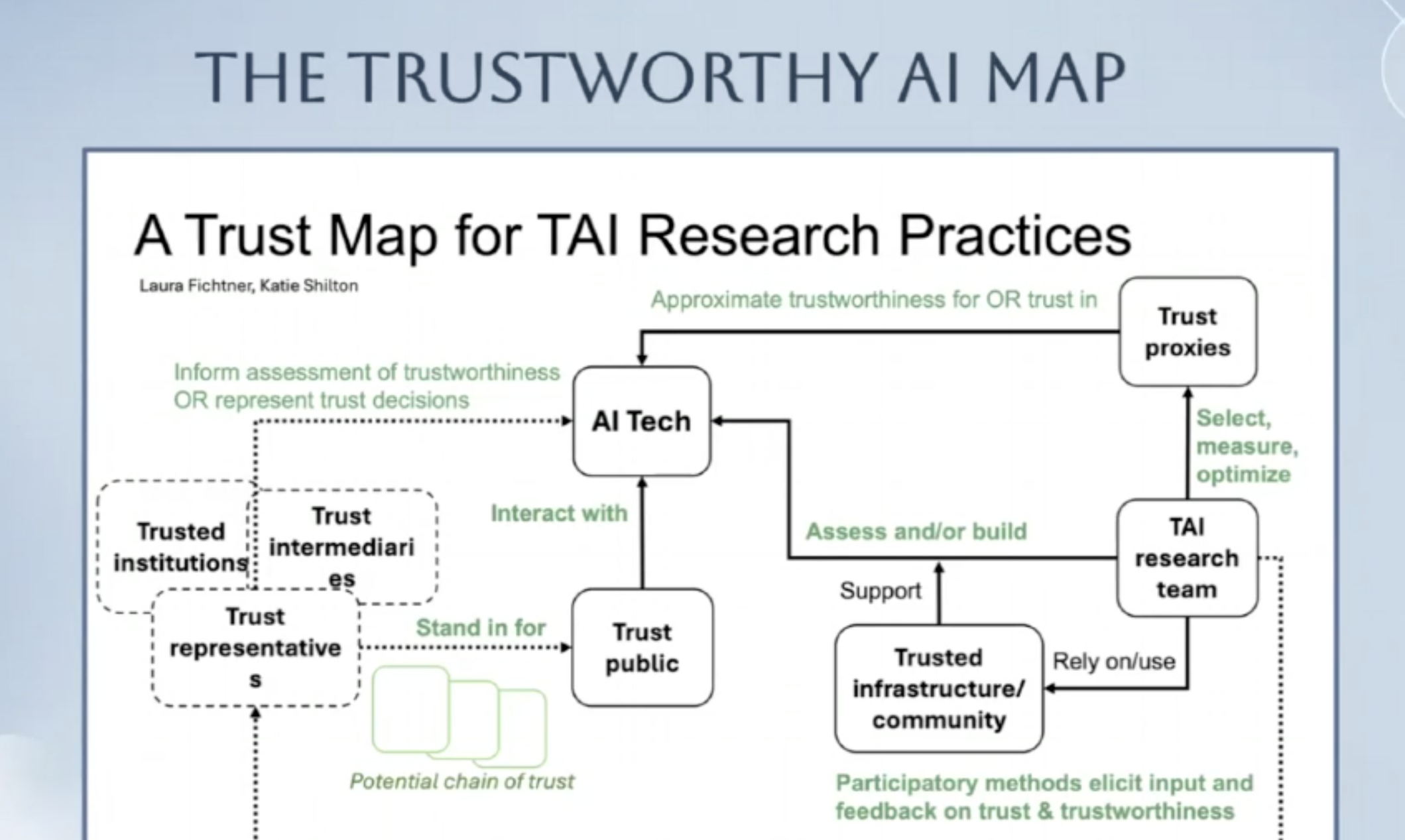
“There is no one-size-fits-all definition for trustworthiness for AI systems,” Fichtner said. “The tool that the TRAILS summer fellows developed supports AI researchers in understanding and defining trustworthiness in the context of their work, document and describe their decisions and exchange perspectives within the team.”
A collaborative workspace allows research team members to compare their reflections, identify differences and work toward consensus. Bhatta, a computer engineering major at Morgan State University, also prototyped a “Resource Finder” feature that would search OpenAlex, a database of academic papers, to find 15 relevant articles, rank passages using a sentence-transformer model and generate answers grounded in those sources.
To ensure the platform addressed researchers’ practical needs, the fellows surveyed AI researchers about their approaches to trustworthy AI. They also conducted semi-structured interviews and think-aloud prototype testing with the participants.
A first testing indicated that the guided framework helped participants articulate and organize ideas they had previously considered only internally.
“Through the writing process, you are reflecting and critiquing as you go with every word, with every sentence that you’re putting together,” one participant said.
Research participants said the tool could potentially be useful at every stage of the research process.
“I think it fits all of them,” one participant said when asked when research teams should use the platform. “It’s an iterative process, and that’s why I like the fact that you can go back and edit. It should be a tool that they go back to at each stage.”
They also valued the collaborative workspace and suggested using AI models to summarize areas of agreement and disagreement among team members’ responses. Chavan, who studies political science and data science at George Washington University, said pausing for reflection can help researchers identify problems early.
“I actually think that in terms of research, it is really important that you stop and reflect before you keep moving on, because it can catch a lot of problems that you might not have thought of in your research, and it can help you save time in the future by addressing problems now rather than later,” she said.
The project gave the fellows experience in software engineering, user research and AI governance while allowing them to develop a resource for the broader research community.
“AI governance must continue to evolve as AI systems become more advanced, whether that be through the voluntary frameworks or within legislation,” Keita said. “Doing this will help researchers standardize their practices and develop more adaptable AI regulations.”
—Story by Diya Sharma, UMIACS communications group