
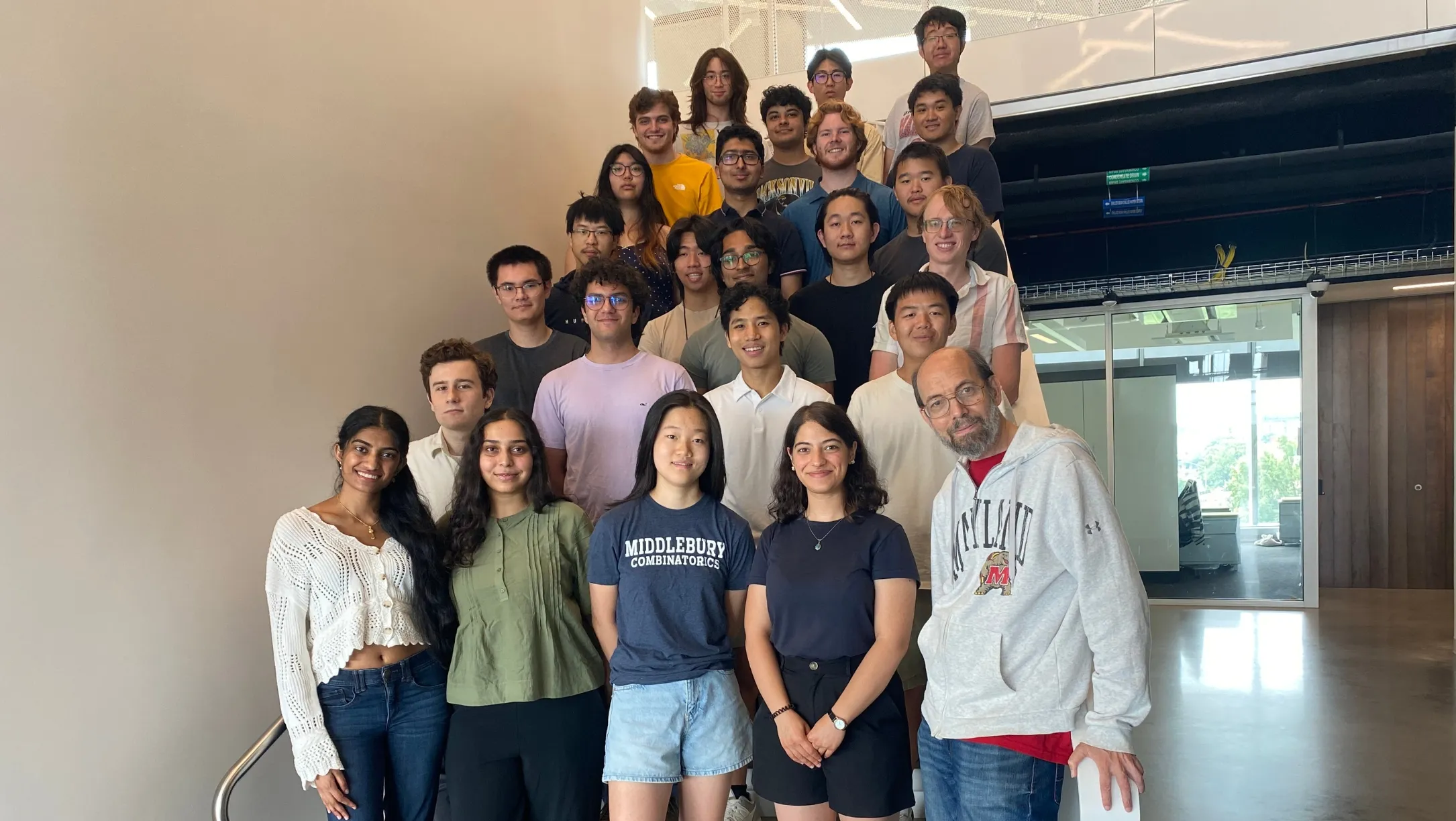
Computer science and mathematics can seem abstract in the classroom. But at the University of Maryland this summer, 27 undergraduates are applying those concepts to problems ranging from reconstructing evolutionary trees to probing the limits of artificial intelligence.
The students are participating in the Research Experience for Undergraduates in Combinatorics and Algorithms for Applied Research (REU-CAAR), a competitive, 10-week National Science Foundation-funded program. Selected from nearly 400 applicants, this year's cohort is working alongside UMD faculty and graduate student mentors on seven research teams tackling a broad range of computational and mathematical challenges.
The program concludes Aug. 7 with students presenting the results of their summer projects. Participants also attend weekly seminars, professional development workshops and campus events that introduce them to graduate-level research.
“The goal is to give students an on ramp into research,” said William Gasarch, professor of computer science and the program's principal investigator. "They're learning not only the technical skills, but also how research works as a collaborative process."
Several research teams are led by faculty with appointments in the University of Maryland Institute for Advanced Computer Studies (UMIACS). On those teams, students are applying algorithm design to challenges in computational biology, artificial intelligence and parallel computing.
For Owen Chen, a junior double majoring in computer science and mathematics at Dartmouth College, that has meant stepping into an unfamiliar field.
Working with Erin Molloy, assistant professor of computer science with an appointment in UMIACS, Chen is helping develop algorithms for phylogeny reconstruction—the process of rebuilding evolutionary relationships using genomic DNA data.
These computational pipelines often amplify small errors, reducing the accuracy of evolutionary trees. Chen's work explores ways to make those algorithms more resilient to uncertain data.
“Computational biology is entirely new to me, but applying algorithm design to genetic data has been an incredible challenge,” Chen said. “Right now, my main focus is doing good research and finding ways to make these evolutionary trees more accurate.”
For Molloy, bridging the gap between artificial intelligence and computational biology offers a fresh perspective on stubborn scientific problems.
"Owen has brought to our group his enthusiasm for artificial intelligence,” Molloy said. “He has been working closely with Ph.D. student Junyan Dai to integrate machine learning techniques into phylogenetic reconstruction, with the goal of improving resiliency to error-prone and sparse inputs. Machine learning has yet to be widely adopted in phylogenetics, so this work has the potential to greatly advance the state-of-the-art; I am excited to see what they find over the course of the summer.”
Nathan Nguyen, a junior majoring in computer science at Harvey Mudd College, is exploring a different challenge under Jordan Boyd-Graber, professor of computer science with an appointment in UMIACS.
Their team studies the strengths and limitations of large language models through Quiz Bowl, a fast-paced trivia competition in which players answer increasingly specific clues. By comparing human and AI performance, the researchers hope to better understand where today's AI systems excel—and where they still struggle.
Nguyen said working in Boyd-Graber's lab immersed him in Maryland's collaborative research environment.
Other REU-CAAR students are working with Laxman Dhulipala, assistant professor of computer science with an appointment in UMIACS, to design algorithms that process enormous datasets more efficiently. Their work explores how computers can divide complex problems across many processors while reducing the time spent moving data between memory and storage—an increasingly important challenge as modern datasets continue to grow.
These projects represent just a sample of the work taking place across REU-CAAR. Gasarch has seen that breadth firsthand while mentoring eight students working on Ramsey theory, a branch of mathematics that studies how order emerges within large, complex systems.
That sustained student interest has helped make REU-CAAR one of the nation's longest-running REU programs, operating continuously since 2013.
“The students keep getting better every year,” Gasarch said. “There are more research opportunities now at a lower level that feed into this program. We're seeing more high school and early college students engaging in research before they even get here.”
For Chen and Nguyen, the experience has made graduate school feel more attainable.
“Before coming here, the idea of a Ph.D. felt incredibly abstract and distant,” Nguyen said. “But being trusted to drive a real project in a top-tier lab changes your perspective.”
—Story by Melissa Brachfeld, UMIACS communications group