
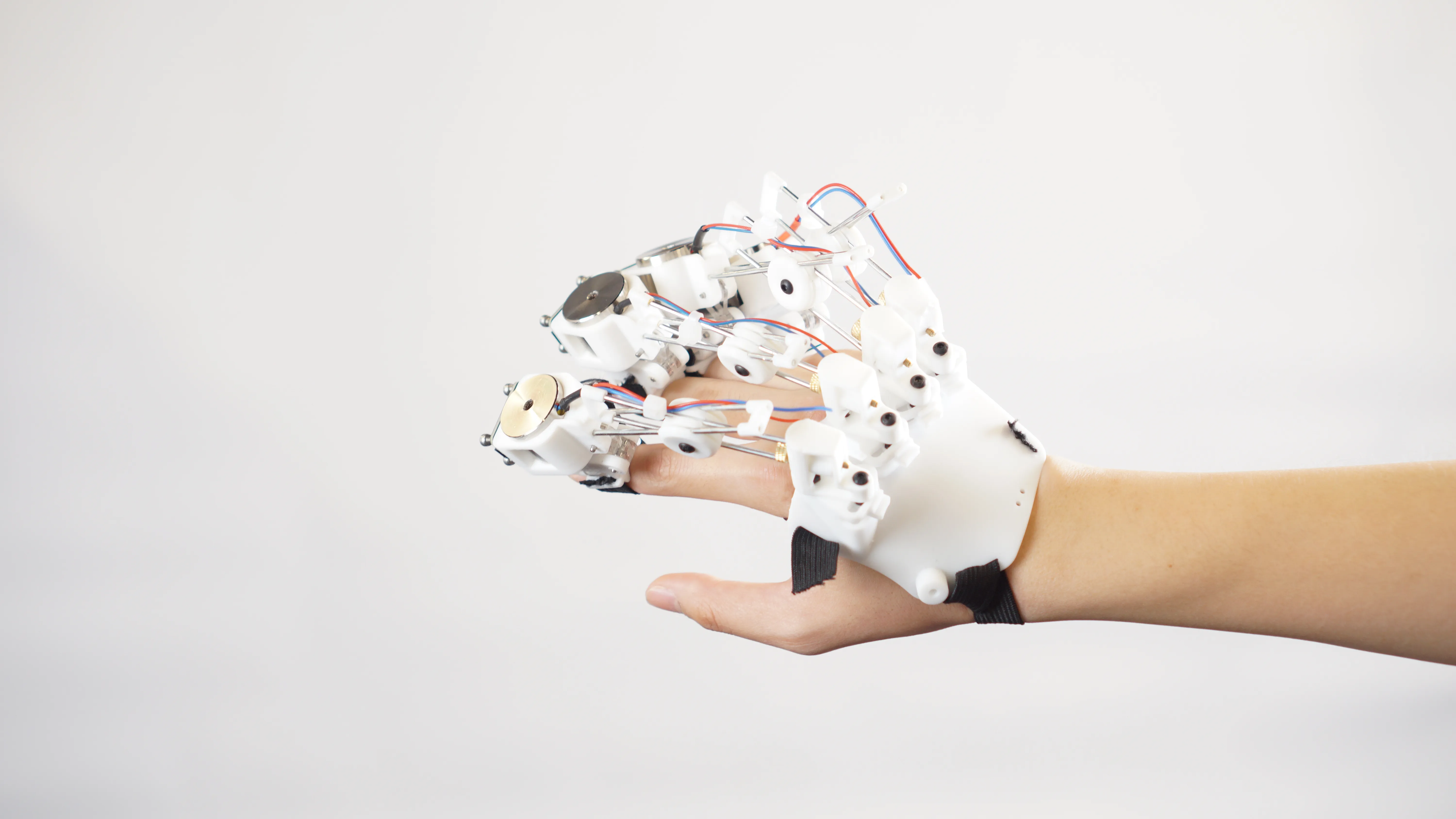
From learning to play an instrument to performing a surgical procedure, mastering physical skills often depends on repetition and correcting mistakes over time. University of Maryland (UMD) researchers in human-computer interaction are examining whether haptic technology can reshape that process by physically nudging users earlier in motor execution, rather than relying solely on post-error correction.
Kyungyeon Lee, a computer science Ph.D. student at UMD, is contributing to that research by exploring how hand exoskeleton systems can support motor sequence learning through preemptive feedback.
Lee developed a hand exoskeleton that shows how real-time error sensing can be paired with physical intervention. The system uses electromagnetic actuators and magnetic field sensors to detect and physically prevent users from making errors before they occur, with the entire sequence happening within 150 milliseconds.
In experimental studies, Lee found that preemptive feedback influenced how users approached learning, with participants showing increased confidence, greater awareness of potential errors, and improved learning performance compared with traditional feedback methods.
Although the study evaluated participants in a simple rhythm game task, the same concepts and training systems could be carried over to more high-stakes settings.
“In high-stakes training environments—like for pilots, surgeons, or air-traffic controllers—errors can be costly or dangerous, and systems that intervene before a mistake is made could change how people are trained for these roles,” Lee says.
Her paper outlining the project received the Best Paper Honorable Mention Award at the Association for Computing Machinery Conference on Human Factors (ACM CHI 2026) in Barcelona, Spain, ranking among the top 5% of 6,740 submissions.
“Having this work accepted at ACM CHI with an Honorable Mention is very meaningful,” she says. “Our work takes a different strategy from the mainstream that skill learning relies solely on guidance, so it was especially rewarding to see this approach recognized.”
Lee is advised by Jun Nishida, an assistant professor of computer science with an appointment in the University of Maryland Institute for Advanced Computer Studies who co-authored the award-winning paper.
“Kyungyeon is a diligent and reliable researcher who consistently brings projects to completion. It is fascinating to see that she has been developing engineering skills from scratch while articulating a coherent research vision,” says Nishida.
Looking ahead, Lee said her future work will continue to examine how physical skills are learned.
“Learning new skills is inherently challenging but exciting,” she explains. “I would like to establish new ways to make this process not only effective, but also more empowering by enhancing users’ sense of agency and competence through personalization. I hope that haptic technologies can augment our physical capabilities, embodied knowledge, and the quality of our lives, as AI continues to advance."
—Story adapted from the Department of Computer Science