
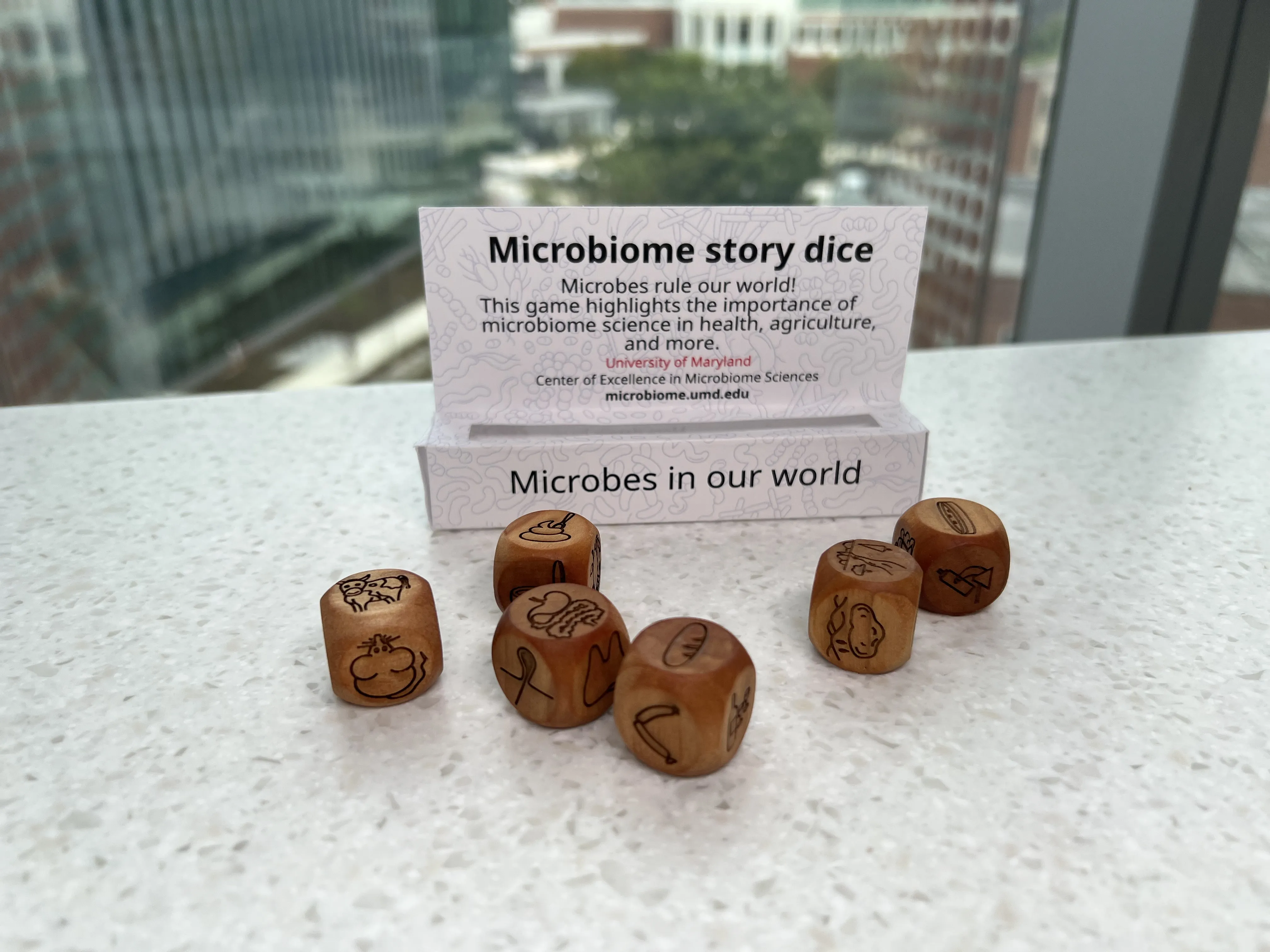
A chicken, a loaf of bread, a toxic spill, a river, medication and cloud computing might seem like the ingredients of an unusually complicated research project. For players of a new game developed at the University of Maryland, they are an invitation to explore how microorganisms shape human health, agriculture and the environment.
The microbiome story dice game was the idea of Mihai Pop, an MPower Professor of computer science and co-director of the University of Maryland Center of Excellence in Microbiome Sciences. Designed to spark conversation and creativity, the game challenges players to connect symbols engraved on six dice and use them to describe a hypothetical microbiome study.
“The microbiome affects nearly every part of our lives, from the food we eat to the health of our bodies and the environment,” said Pop, who has an appointment in the University of Maryland Institute for Advanced Computer Studies (UMIACS). “The dice give people a playful way to make those connections and imagine the kinds of questions microbiome scientists ask.”
Members of the microbiome center and other researchers helped pilot and refine the game. Terrapin Works laser-engraved the dice, while their storage boxes were made by Pop at the Rockville Makerspace.
To play, participants take turns rolling six dice. Each die displays microbiome-related images representing animals, foods, ecosystems, parts of the body, environmental challenges or research tools. A player must create a plausible study incorporating as many symbols as possible, earning one point for each die used if the other players accept the story.
A roll showing a chicken, medication, bread, a toxic spill, a river and cloud computing could inspire a proposal for a cloud-based platform to identify antibiotic-resistant bacteria entering rivers from poultry farms. That story would earn five points if it used every symbol except bread.
Another player might combine the chicken, medication and bread to suggest studying whether feeding sourdough bread to chickens could reduce antibiotic use on poultry farms. That story would earn three points.
Players can modify the rules by competing to produce the most stories from one roll, selecting the most compelling or outlandish proposal, or judging which idea would be most likely to receive research funding. In a cooperative version, participants build a single story using all six dice.
The symbols reflect the breadth of microbiome science. Some represent humans and animals, while others depict body systems, fermented foods, ecosystems and research tools such as microscopes, sequencing machines, cloud computing and the programming languages R and Python.
Each image is intentionally open to interpretation. A lung might represent the human respiratory system or, when paired with a fish, its gills. Bread could point to sourdough fermentation, food safety or bacterial compounds that extend shelf life.
That flexibility makes the game suitable for several settings. It can serve as an icebreaker at scientific meetings, a classroom activity, a public outreach tool or a starting point for developing research ideas. Instructors can ask students to connect a roll with course material, while scientists can use the symbols to demonstrate the reach of microbiome science.
Researchers could also search for a published paper matching a rolled story. If none exists, the combination might suggest a question worth investigating.
The center has produced a limited number of sets for use in classes and at conferences. Pop is now gauging whether broader interest could support production on a larger scale.
—Story by UMIACS communications group