
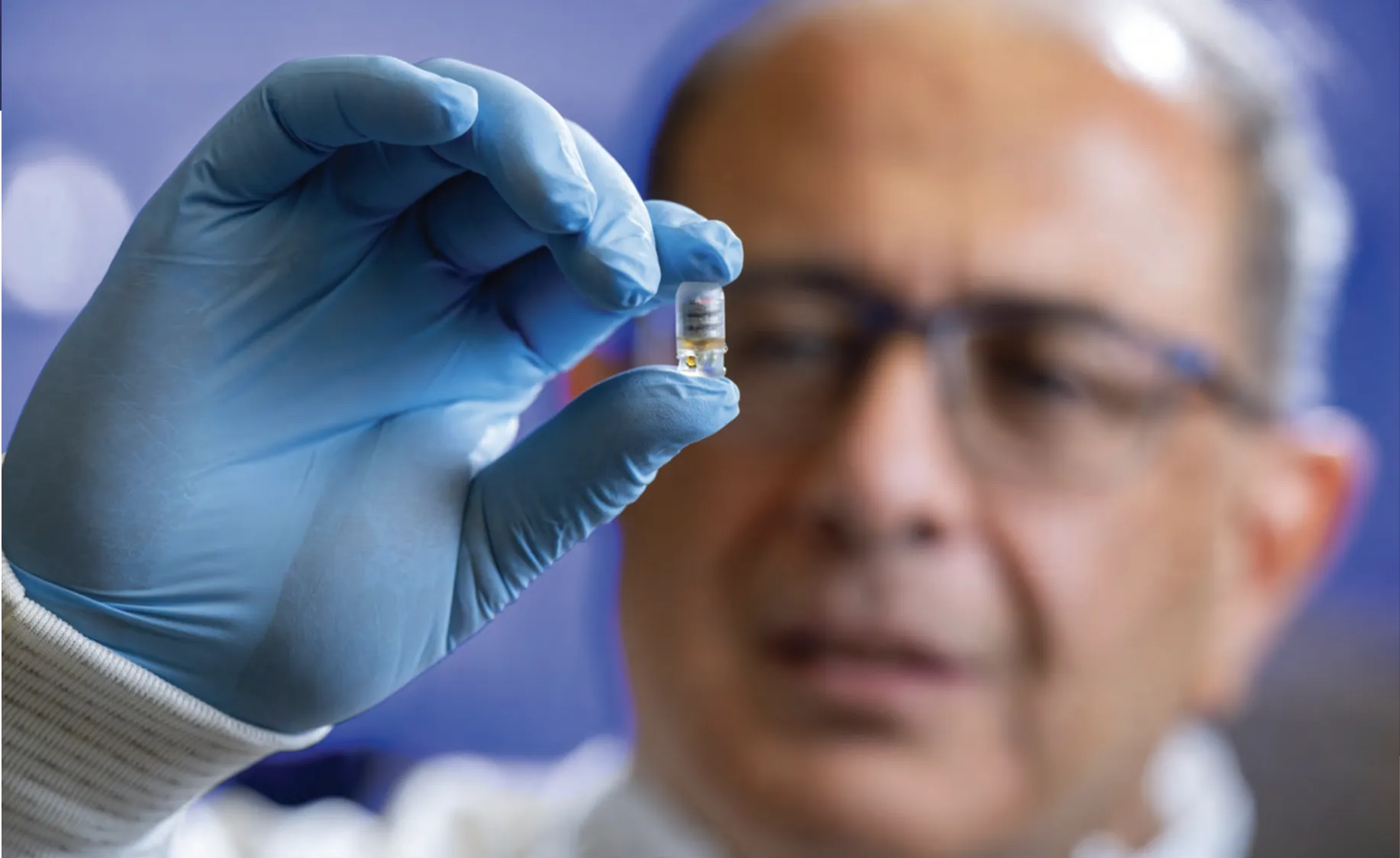
A team of researchers at the University of Maryland (UMD) tackling how we track our gut health recently received a National Institutes of Health (NIH) R21 grant to support the next phase of their work—improving the sensors in their digestible smart pill to ensure that data is acquired accurately The team is led by Reza Ghodssi, the Herbert Rabin Distinguished Chair in Engineering, executive director of research and innovation at UMD’s MATRIX Lab, and a member of the UMD Center of Excellence in Microbiome Sciences.
“This will greatly expand the research scope of our ingestible capsule work. We are taking a systems approach to improving the reliability of ingestible sensors beyond what we previously thought was possible,” Ghodssi said. “Establishing trusted measurements is essential to unlocking the next generation of autonomous, closed-loop technologies for the GI tract. We thank the National Institutes of Health for supporting this life-changing work.”
The work, which began at the University of Maryland, College Park campus, will now extend to Southern Maryland, into the UMD MATRIX Lab. Ghodssi’s co-PIs, including Younggeon Jin, assistant professor of animal and avian sciences; Justin Stine, assistant research scientist in the Clark School of Engineering at the USMSM MATRIX Lab; and Pankaj Pasricha, a neurogastroenterologist at the Mayo Clinic, bring their interdisciplinary expertise to the work.
Earlier, Less Invasive Detection
The smart pill is being developed to support patients with Crohn's disease and ulcerative colitis, which are collectively known as inflammatory bowel disease (IBD). IBD causes severe inflammation in the gastrointestinal (GI) tract. However, because inflammation is a common symptom across a variety of disorders, getting an accurate diagnosis can be complicated.
Currently, doctors use capsule endoscopy—a minimally invasive tool that takes images of the GI tract—to help diagnose patients. While useful, these imaging capsules are typically only used after symptoms appear, and they do not provide quantitative health measurements.
To gather specific diagnostic data and assess intestinal tissues before they become symptomatic, Ghodssi's team is utilizing bioimpedance: a measure of how the body resists electrical current flow. Because inflamed tissue is more permeable and often contains excess fluid and disrupted cell barriers, its electrical conductivity changes. This makes bioimpedance a highly promising technique for measuring inflammation.
Advancing and Improving the Capsule
While the researchers have previously explored bioimpedance as a monitor for inflammation, these earlier studies focused on the esophagus since measurements can vary greatly depending on the patient and the location within the GI tract. Furthermore, inconsistent sensor contact with the intestinal walls can obscure the real-time data needed to correlate electrical impedance with actual inflammation.
With the NIH R21 grant, Ghodssi’s team will address this hurdle by designing mechanisms to detect and verify solid sensor contact, ensuring the resulting data is reliable.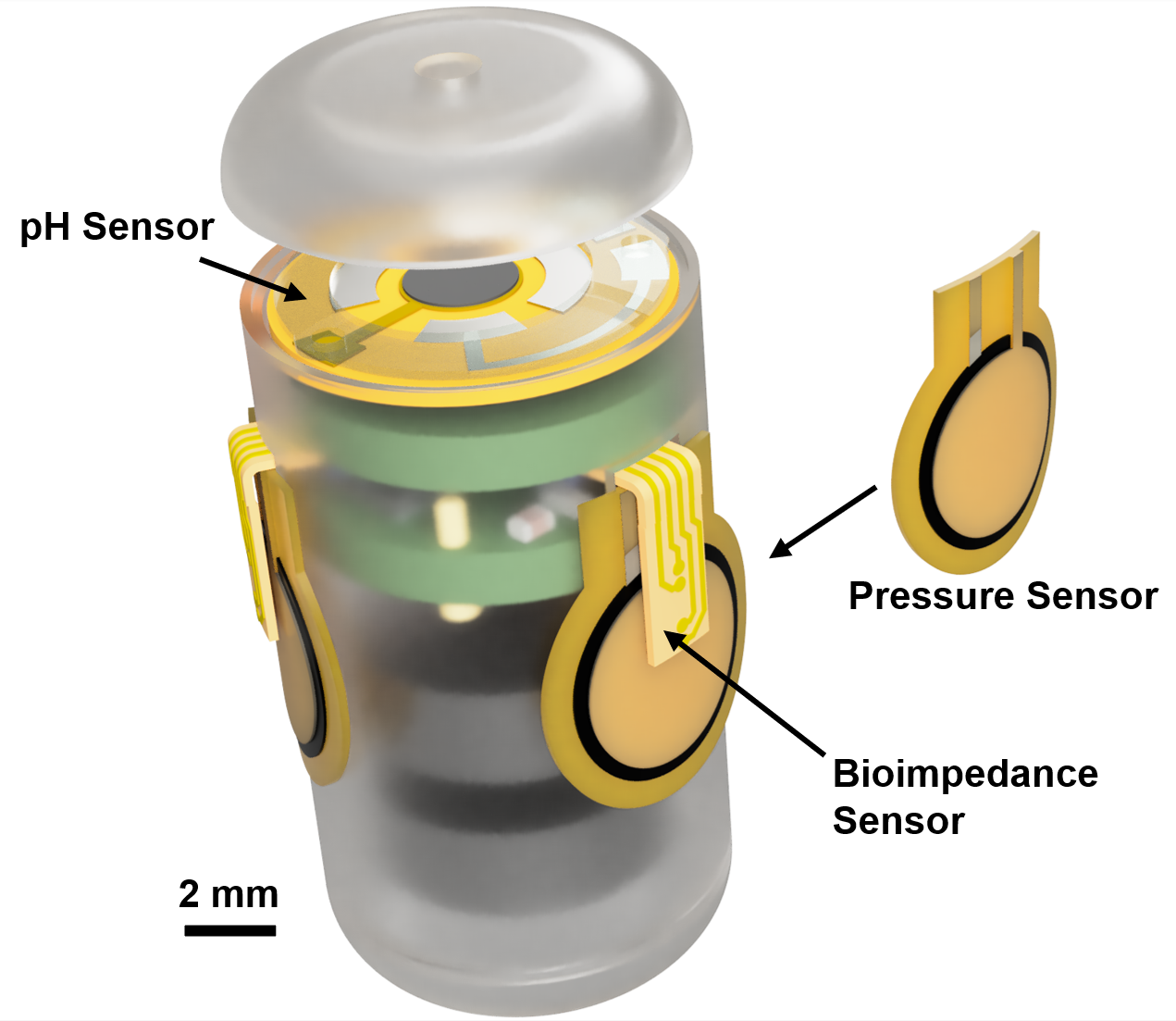
The MATRIX Lab’s Advanced Manufacturing Lab (AML @ SMART), where co-PI Stine serves as Director of Remote Sensing and Microsystems, is fully equipped to support this new phase of the project and will be used to develop the capsule's packaging, integrate the sensors, and evaluate the newest prototypes.
“The GI tract presents a challenging sensing environment; we employ biofeedback and multimodal sensing to account for measurement variability,” said Stine. “We look forward to advancing this work with the team and realizing a viable prototype.”
Ultimately, this new iteration of the capsule is expected to expand capabilities for proactive disease monitoring and personalized treatment, improving long-term patient outcomes. Moving forward, the team will focus on building and validating the sensing system in controlled environments before testing its safety and real-world performance inside living organisms.
(Note: The ingestible capsule is currently in the prototype phase and is not yet available for clinical use.)
—This story was adapted from an article by the Department of Electrical & Computer Engineering