
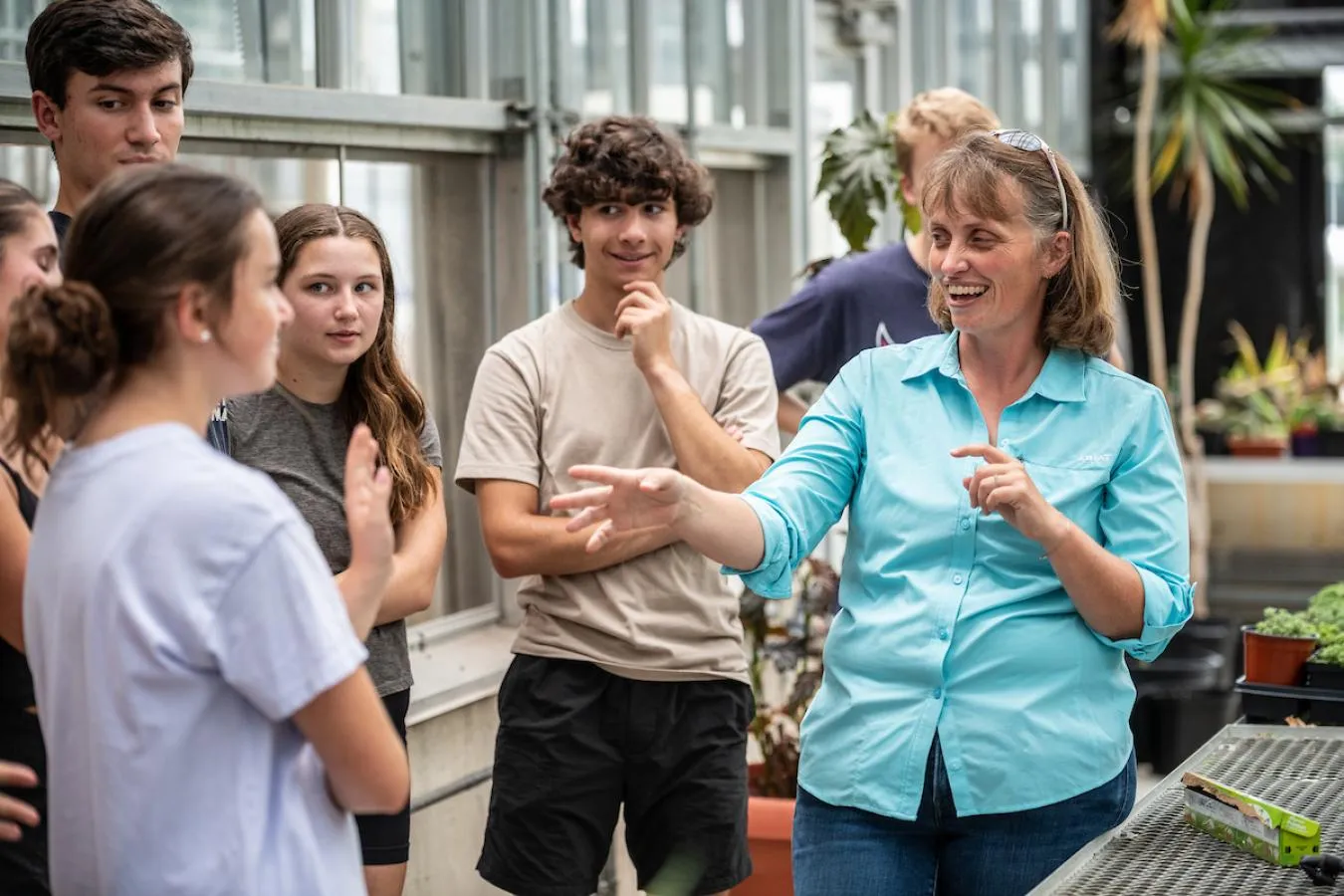
Stephanie Yarwood, a professor of environmental science and technology, co-director of the UMD Center of Excellence in Microbiome Sciences and an internationally recognized expert in soil microbes, has been named the Ray R. Weil Endowed E-Nnovate Professor in Soil Science.
As the second faculty member to hold the title, Yarwood will use the endowment to expand research aimed at improving soil health, advancing sustainable agriculture and helping farmers reduce costs through more efficient nutrient management.
“This new funding will allow me to build on research that we have been doing,” Yarwood said. “We will expand our work examining the fate of new carbon into the soil from winter cover crops.”
Her research focuses on soil microbiomes—the communities of bacteria, fungi and other microscopic organisms that drive nutrient cycling, plant growth, carbon storage and ecosystem resilience. By better understanding these microscopic ecosystems, Yarwood hopes to develop farming practices that improve environmental outcomes while maintaining strong crop yields.
A major component of the funding will support a new field experiment designed to track how carbon moves through agricultural systems and where it is ultimately stored in the soil. Using advanced analytical techniques, Yarwood and her team will study how cover crops contribute to carbon sequestration, a process that can improve soil health while helping mitigate climate change.
The project will also explore new approaches to recycling agricultural and food waste. Yarwood plans to partner with industry collaborators to evaluate the environmental and agronomic benefits of applying recycled food and poultry waste products to farmland. Returning nutrients and organic matter to the soil could reduce reliance on commercial fertilizers, improve soil productivity and create new uses for agricultural byproducts.
Because the professorship is partially supported through the Maryland Department of Commerce’s E-Nnovate program, the research also has a strong economic focus. In addition to studying environmental benefits, Yarwood’s team will investigate how stronger markets for recycled agricultural products can reduce costs for farmers and support Maryland’s agricultural economy.
The endowment will also enhance educational opportunities by helping purchase specialized laboratory equipment, expand research capacity and provide hands-on training for undergraduate and graduate students pursuing careers in soil science, microbiology and environmental sustainability.
Established in 2018, the Ray R. Weil Endowed E-Nnovate Professorship in Soil Science supports teaching and research within the Department of Environmental Science and Technology. The professorship was created through a $1 million gift from distinguished UMD soil scientist Ray Weil, matched through a state program designed to encourage applied research with economic impact.
“Stephanie is highly respected internationally for her specialized work in understanding soil microbiomes using cutting-edge DNA techniques,” said Weil. “Her world-class, soil-centric research and highly regarded teaching make her an excellent candidate for this endowed professorship.”
Throughout her career, Yarwood has studied how agricultural practices and ecosystem restoration efforts shape microbial life in soil. Her research has helped reveal how these communities influence greenhouse gas emissions, nutrient cycling and carbon storage—insights that can inform more productive and resilient farming systems.
“I am honored to receive the professorship,” Yarwood said. “The collegial environment and commitment to our discipline have provided me with a strong foundation for my own research and teaching efforts.”
The new funding will help Yarwood expand field research, strengthen industry partnerships and train future soil scientists while advancing new approaches to carbon management and agricultural waste recycling.
—Story by Diya Sharma, UMIACS communications group