
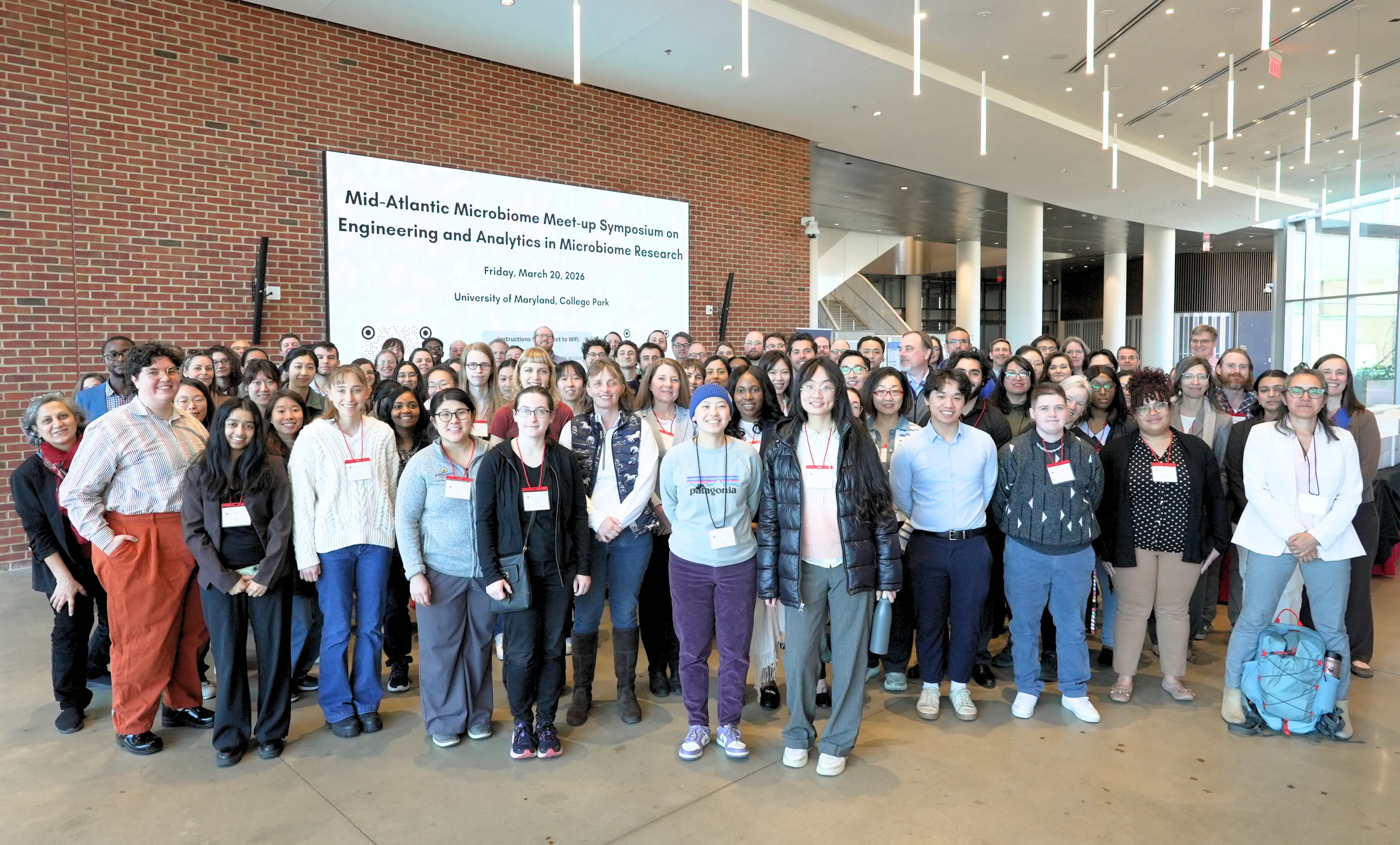
More than 120 researchers convened at the University of Maryland on Friday, March 20, for the 10th annual Mid-Atlantic Microbiome Meet-up.
The one-day symposium, held at the Brendan Iribe Center for Computer Science and Engineering, brought together a diverse community of microbiome scientists from across the Mid-Atlantic region and beyond, spanning academia, government and industry.
This year’s theme, “Engineering and Analytics in Microbiome Research,” underscored the growing importance of quantitative methods, high-throughput sequencing technologies, and systems-level modeling in understanding complex microbial ecosystems. As microbiome datasets continue to expand—encompassing metagenomics, metatranscriptomics, and metabolomics—researchers are developing new computational frameworks to address persistent challenges such as data sparsity, compositional bias, and reproducibility.
Also, the event organizers said, we are now at a point where the body of knowledge accumulated within microbiome science is enabling the rational design and engineering of microbial communities for varied applications.
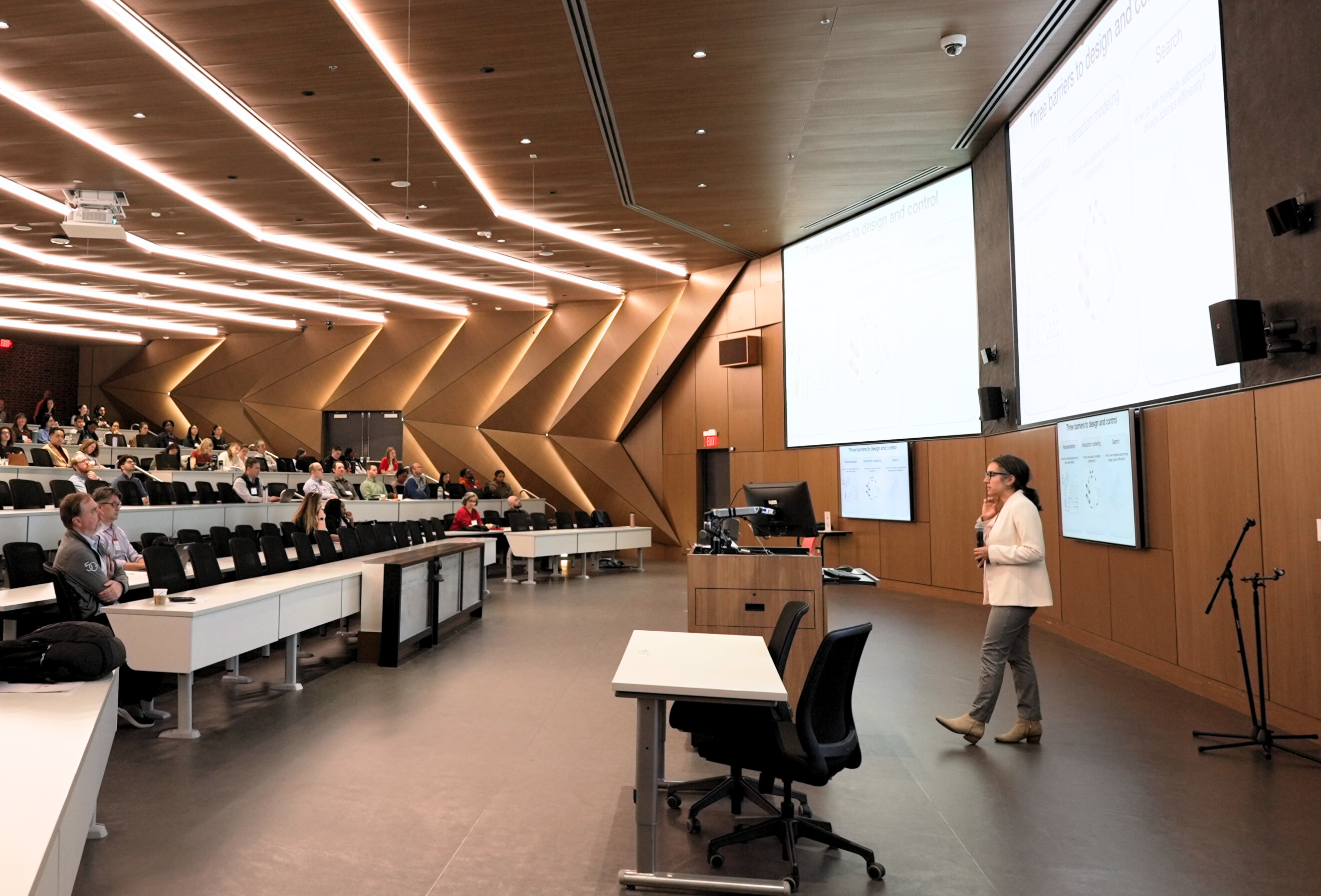
“Events like the Mid-Atlantic Microbiome Meet-up aim to accelerate progress by fostering collaboration and knowledge exchange across disciplines,” said Todd Treangen, associate professor of computer science and bioengineering at Rice University, who opened the event with remarks reflecting on its 10-year history.
The symposium featured keynote presentations from Ophelia Venturelli of Duke University, who discussed engineering diet- and probiotic-based interventions to enhance gut microbiome resilience, and Amy D. Willis of the University of Washington, who examined the effects of model misspecification on differential abundance analyses.
“Over the past decade, we’ve seen microbiome research evolve from largely descriptive studies to a field driven by predictive models and engineered systems,” said Mihai Pop, professor of computer science at the University of Maryland and one of the event’s organizers. “This meeting reflects how quickly the science is maturing and where it’s headed next.”
Across three technical sessions—Computational Tools Innovation, Microbiome in Environment and Health, and Microbiome Engineering & Wet Lab—participants presented new methods and experimental findings. Highlights included an open-source modular framework for ensemble long-read metagenomic analysis; a time-series study of microbial community responses to aeration changes in a eutrophic estuary; and approaches for designing high-yielding, resilient synthetic microbial consortia for medium-chain carboxylic acid production.
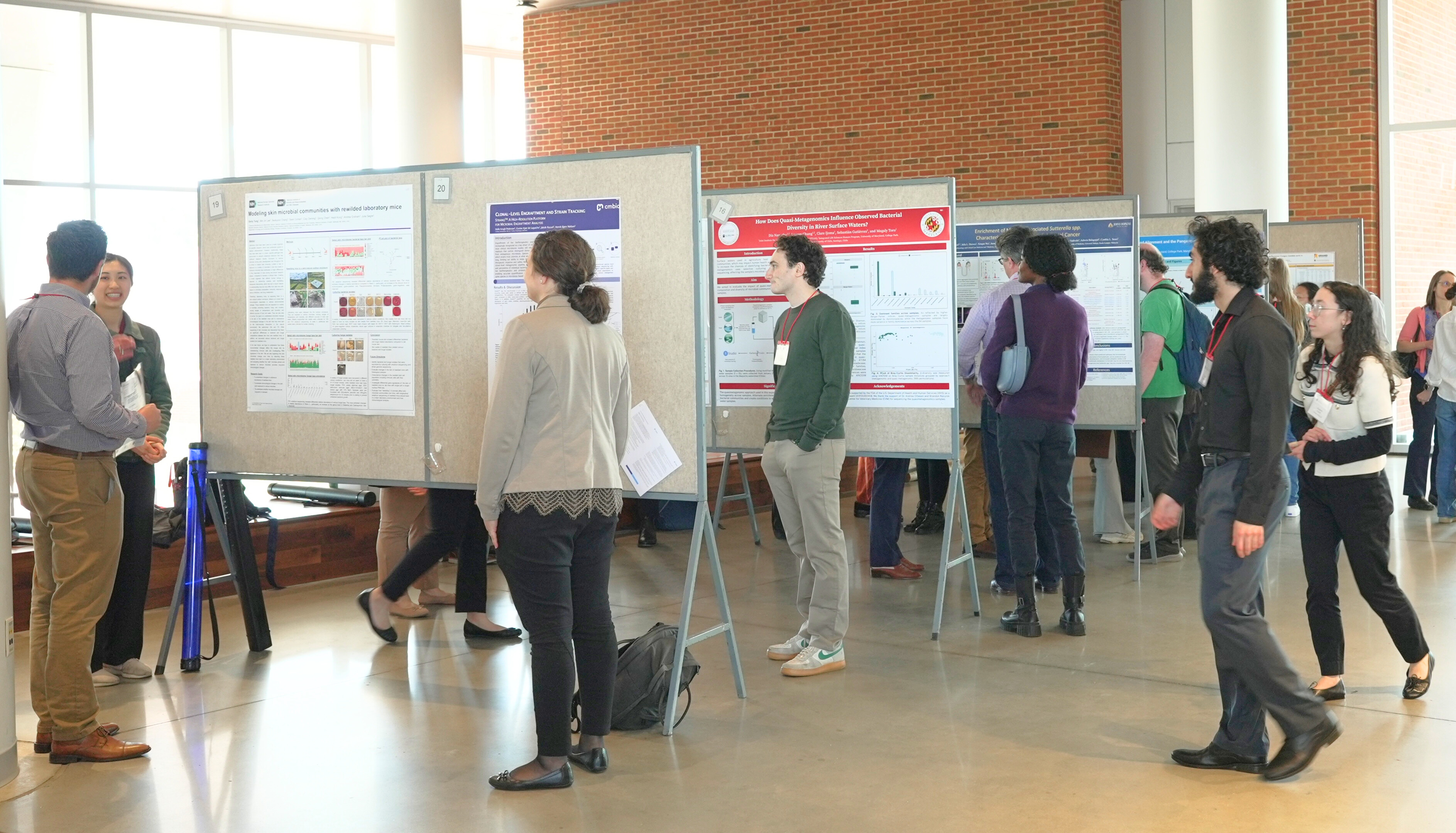
Poster sessions and breakout discussions further explored key challenges in the field, including improving quantitative accuracy in metagenomic sequencing through internal standards, identifying multidrug-resistant biofilm-forming environmental strains, evaluating quasi-metagenomic approaches in aquatic systems, and modeling skin microbiomes using rewilded laboratory mouse systems.
The symposium concluded with a reception that provided additional opportunities for networking and collaboration.
Sponsors included AmpSeq, the University of Maryland Grand Challenges Grants Program, and the University of Maryland Institute for Advanced Computer Studies (UMIACS), which also provided logistical support.
—Story by UMIACS communications group