
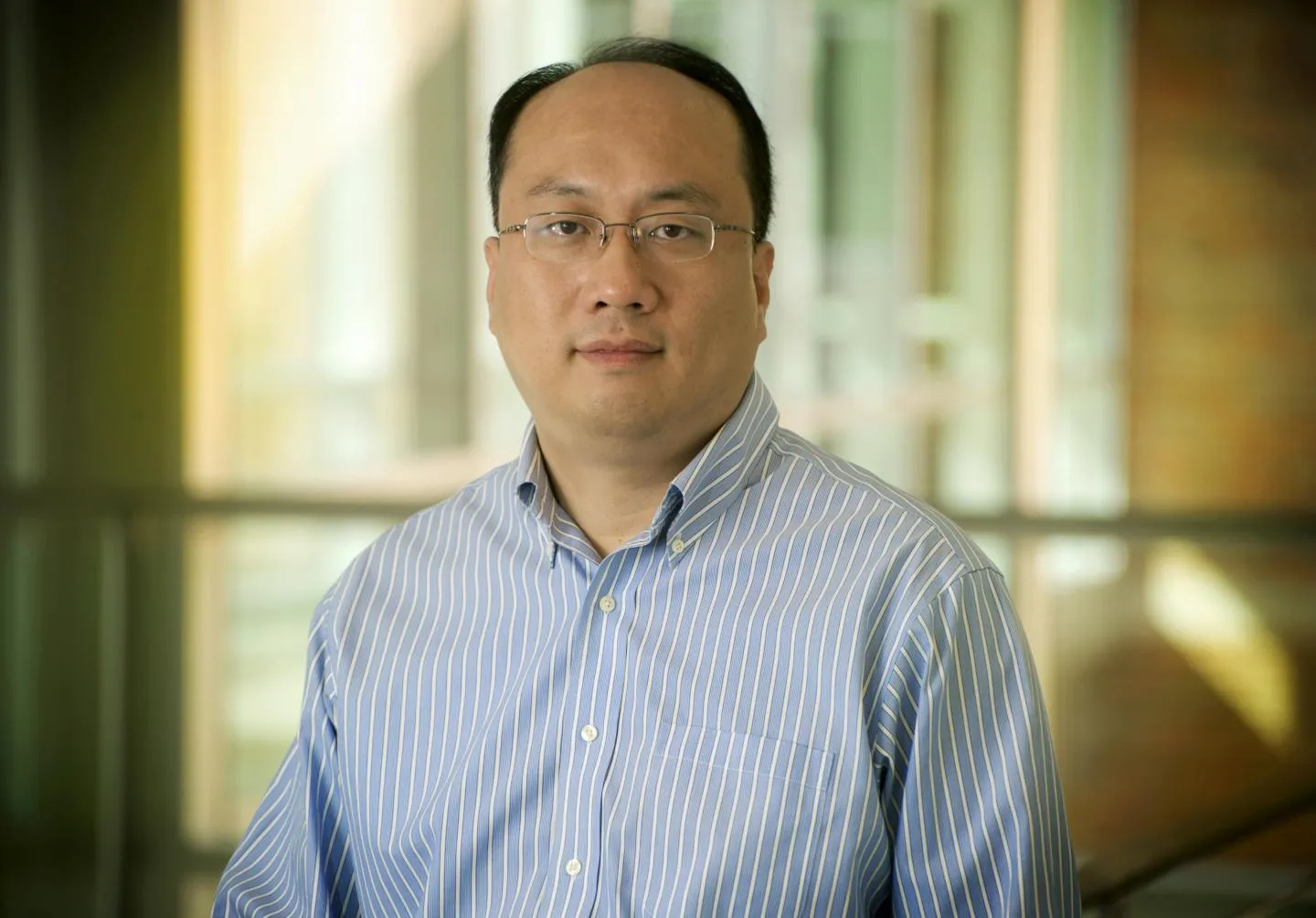
Heng Huang is part of two new federally funded projects aimed at improving the use of artificial intelligence in healthcare: a four-year, $1.2 million award to develop a wearable device that predicts hospital readmission in high-risk heart failure patients and a $750,000 contract to create a platform for evaluating AI-enabled medical imaging systems.
“AI has so much potential to help us address human health problems, and developing these kinds of real-world tools is one important way forward,” said Huang, the Brendan Iribe Endowed Professor of Computer Science at UMD.
With the $1.2 million grant, funded jointly by the National Institutes of Health and the U.S. National Science Foundation, Huang will collaborate with Wei Gao at the University of Pittsburgh to develop and test a small, affordable wearable device equipped with AI to be used by patients at home. The device will use magnetic sensing and other sensors to monitor vital signs of patients who have a history of heart failure. New machine learning models will combine the data in real time to predict patients’ risk of hospital readmission.
“Heart failure is the leading cause of hospitalization in older adults, and hospital readmissions after discharge are common and have become the top reason for worse clinical outcomes,” said Huang, who holds an appointment in the University of Maryland Institute for Advanced Computer Studies (UMIACS) and “The problem is especially serious among patients with obesity, who are 30% more likely to require rehospitalization than other heart failure patients.”
The models will enable the researchers to identify risk factors from patients’ everyday vital signs and important biomarkers and predict readmission before it occurs.
“Our ultimate goal is to prevent those hospital returns to help save lives,” said Huang, who is also a member of the Center for Bioinformatics and Computational Biology and the University of Maryland Center for Machine Learning.
Data collected by the device could also help the researchers better identify the mechanisms and symptoms of heart failure and support clinicians in making an initial diagnosis.
Assessing AI-enabled medical imaging
Huang leads applied AI at the University of Maryland Institute for Health Computing (UM-IHC), where he is collaborating with colleagues on a new Food and Drug Administration (FDA)-funded project to create a platform to evaluate AI-enabled medical imaging systems for detecting pulmonary embolism, a condition in which a blood clot blocks an artery.
“This project goes to the question of trustworthiness of clinical AI in patient care. If we’re going to use AI to review radiology scans, we need to be able to evaluate what it gets right and what the failure points are,” said lead awardee Florence Doo, an assistant professor in diagnostic radiology and nuclear medicine at the University of Maryland School of Medicine (UMSOM) who co-leads the AI-enabled medical imaging team in UM-IHC’s Center for Applied AI with Huang . “We are building a test bed, or dashboard, that will let clinicians and the FDA evaluate post-market performance and safety of AI in very precise ways, in a health system and at scale.”
The researchers will first standardize hospital imaging data, radiology reports and hospital reports for use in evaluating medical AI. Those reports will come from nearly 6,000 patient records from the University of Maryland Medical System as well as public datasets.
“We will then deliberately stress-test AI models to see where they fail and document what kinds of mistakes AI makes and under what circumstances,” Huang said.
The team also includes Adam Porter, professor of computer science with an appointment in UMIACS, and Bradley Maron, the Melvin Sharoky MD Professor of Medicine at UMSOM. Porter and Maron are co-executive directors of the UM-IHC.
“It’s not enough to just validate an AI-enabled device on benchmark data at a single point in time; we must also validate that the device works correctly throughout its useful lifetime,” Porter added. “Therefore, post-market evaluation of AI devices is a key focus of this project.”
—Story by Jennifer Holland, College of Computer, Mathematical, and Natural Sciences communications group