
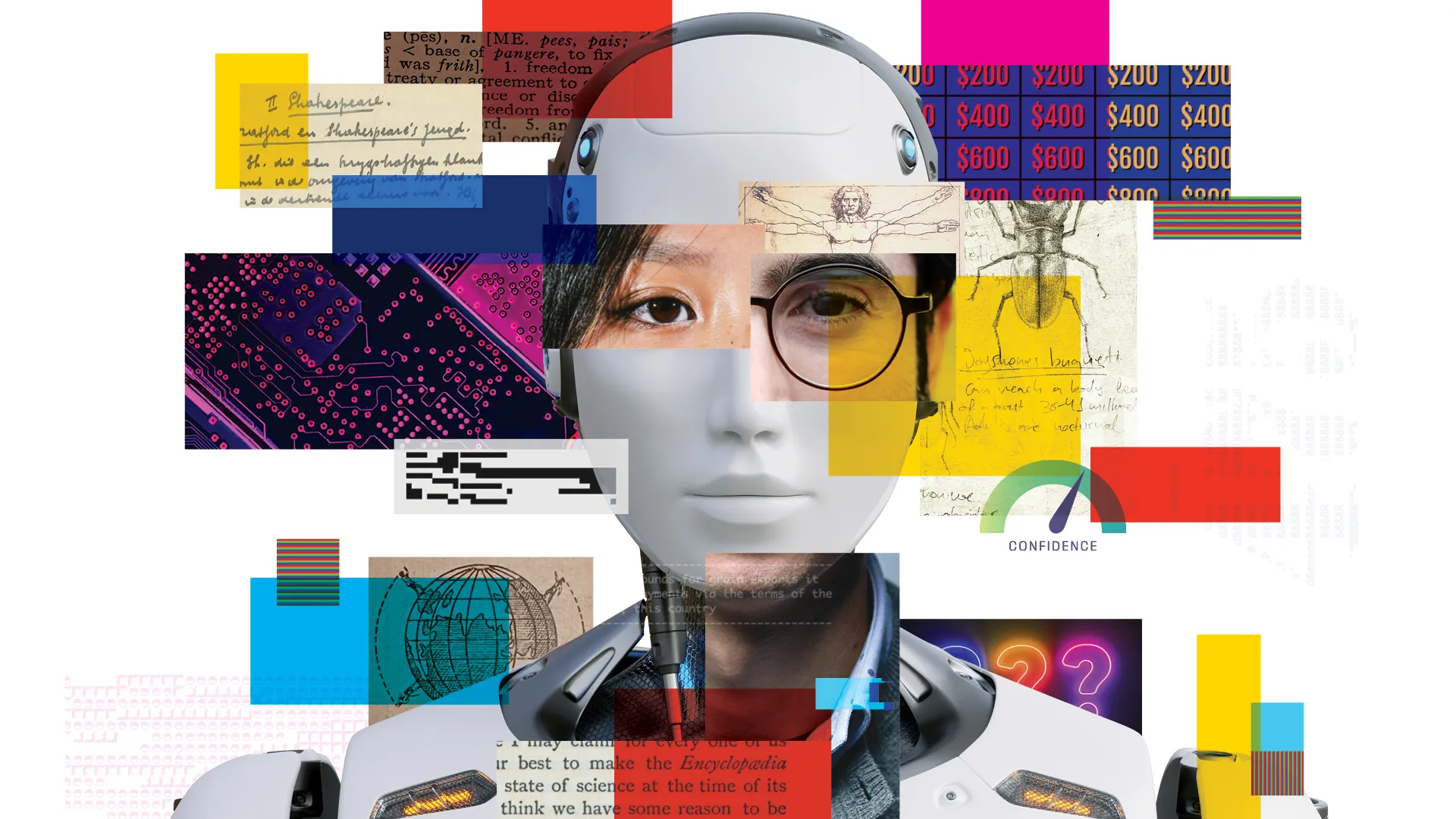
Artificial intelligence has rapidly transformed from a novelty into a powerful tool capable of outperforming even expert humans in some knowledge-based tasks. In “Can AI and People Play Nice?,” Terp explores how University of Maryland computer science professor Jordan Boyd-Graber is using the fast-paced trivia game quizbowl to better understand the evolving relationship between people and AI.
Boyd-Graber, who has an appointment in the University of Maryland Institute for Advanced Computer Studies (UMIACS), has spent more than a decade developing QANTA, an AI system designed to answer quizbowl questions. In a 2019 competition between top human trivia champions and QANTA, people still held a slight edge, particularly on questions requiring creativity, context and lateral thinking. But as AI technology has advanced, systems like QANTA now outperform even highly skilled human competitors on many measures of raw accuracy.
Rather than focusing on AI-versus-human competition, Boyd-Graber’s research now examines how humans and AI can work together effectively. His studies reveal a critical challenge: AI systems are often overly confident in their answers, even when they are wrong, while humans frequently struggle to determine when they should trust AI recommendations and when they should rely on their own judgment.
Through collaborative quizbowl experiments, researchers found that successful human-AI partnerships depend not only on accuracy but also on trust, transparency and self-awareness. People sometimes reject correct AI answers because the system cannot explain its reasoning, while in other cases they defer to incorrect AI suggestions despite having the right answer themselves.
The findings have implications far beyond trivia. As AI becomes increasingly integrated into fields such as health care, finance and decision-making, understanding how people and machines can collaborate responsibly may be just as important as making AI smarter.
Read the full story: “Can AI and People Play Nice?” in Terp Magazine.