
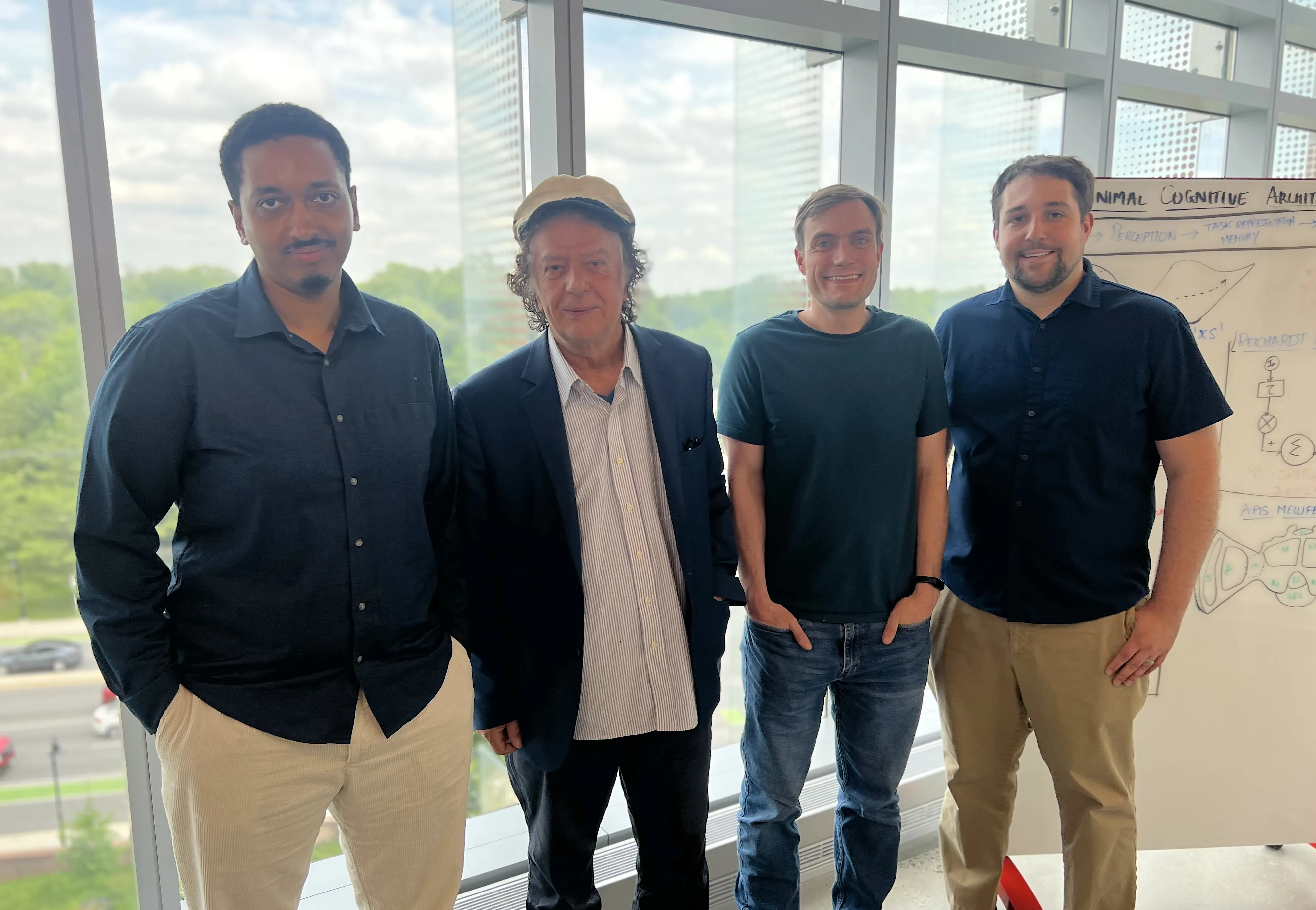
Two University of Maryland researchers will use prestigious Intelligence Community (IC) Postdoctoral Research Fellowships to tackle challenges ranging from atmospheric turbulence to human-machine understanding.
Levi Burner, who earned his Ph.D. in electrical and computer engineering in Fall 2025, and Eadom Dessalene, who will complete his Ph.D. in computer science this summer, have been selected for the highly competitive program, which is funded primarily by the Office of the Director of National Intelligence and supports basic research in areas of strategic interest to the U.S. intelligence community. The fellowships begin in September 2026 and support two years of research.
Both conducted doctoral research in the Perception and Robotics Group under the guidance of Yiannis Aloimonos, a professor of computer science with an appointment in the University of Maryland Institute for Advanced Computer Studies (UMIACS). The group's work emphasizes machine perception, embodied intelligence and learning from real-world interaction.
Though their research paths have diverged, both scholars are using artificial intelligence (AI) to solve a common challenge: helping machines better understand the physical world. Through their fellowships, Burner and Dessalene will pursue projects that combine advanced sensing technologies with AI, enabling systems to interpret information that is difficult or impossible to observe directly.
“Levi and Eadom represent the kind of researchers we strive to develop at Maryland—scientists who are willing to tackle fundamental questions while also pursuing applications with real-world impact,” Aloimonos said. “Their work approaches machine intelligence from different directions, but both are pushing the boundaries of how systems learn from and understand the world around them. Having two of our researchers selected for these fellowships is a tremendous recognition of their accomplishments and potential.”
Seeing Through Atmospheric Turbulence
Burner currently serves as a postdoctoral fellow in both the Maryland Robotics Center and the Intelligent Sensing Lab, where he works with Christopher Metzler, an assistant professor of computer science with an appointment in UMIACS.
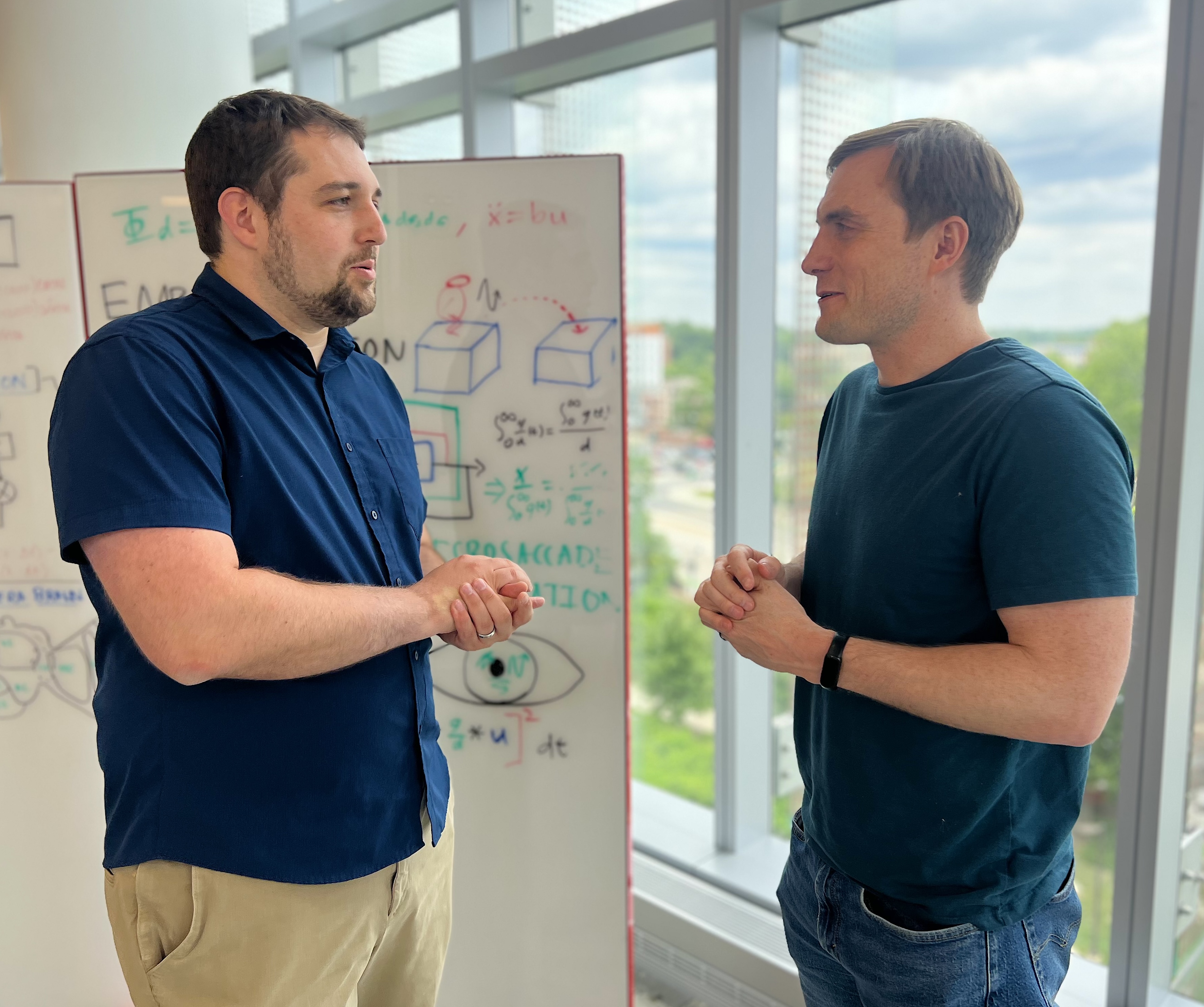
Burner and Metzler will collaborate with a researcher from the U.S. intelligence community to develop new approaches for predicting atmospheric turbulence using advanced imaging systems and AI.
Atmospheric turbulence—the rapidly changing fluctuations in air that distort the path of light—poses a major challenge for long-range imaging and laser-based communication systems. Rather than correcting those distortions after they occur through expensive post-processing, Burner's team aims to predict them on microsecond timescales, allowing systems to compensate for turbulence before it degrades images or communications.
To accomplish this, the researchers will combine two emerging imaging technologies. Single-photon avalanche diode (SPAD) cameras can detect individual photons and capture imagery at microsecond speeds, making them uniquely suited to observing fast-changing atmospheric conditions. The team will also use light-field imaging, which captures multiple views of a scene simultaneously along different atmospheric paths. By comparing these simultaneous views, researchers can separate the chaotic fluctuations of the air from actual motion in the underlying environment when imaging moving targets.
AI will play a critical role in analyzing these massive streams of data and identifying patterns that can be used to forecast atmospheric fluctuations.
“Atmospheric turbulence is one of the most significant barriers to obtaining clear imagery and reliable optical communication over long distances,” Metzler said. “By combining new sensing technologies with machine learning, we're exploring whether these distortions can be predicted before they occur, opening the door to entirely new capabilities in imaging and communication.”
The work could have applications ranging from high-speed, long-range imaging systems to next-generation optical communications in space.
“Much of my research has focused on helping machines build meaningful representations of the world through observation and interaction,” Burner said. “This project applies those ideas to an environment that is constantly changing. We're asking whether AI can learn the underlying structure of turbulence well enough to predict it and improve how imaging systems perceive the world.”
Helping AI Understand Human Actions
Dessalene's fellowship research will continue his collaboration with Aloimonos. The two will pair their expertise with a researcher from the intelligence community to focus on a challenge that remains difficult for even the most advanced AI systems: understanding how humans physically interact with objects.
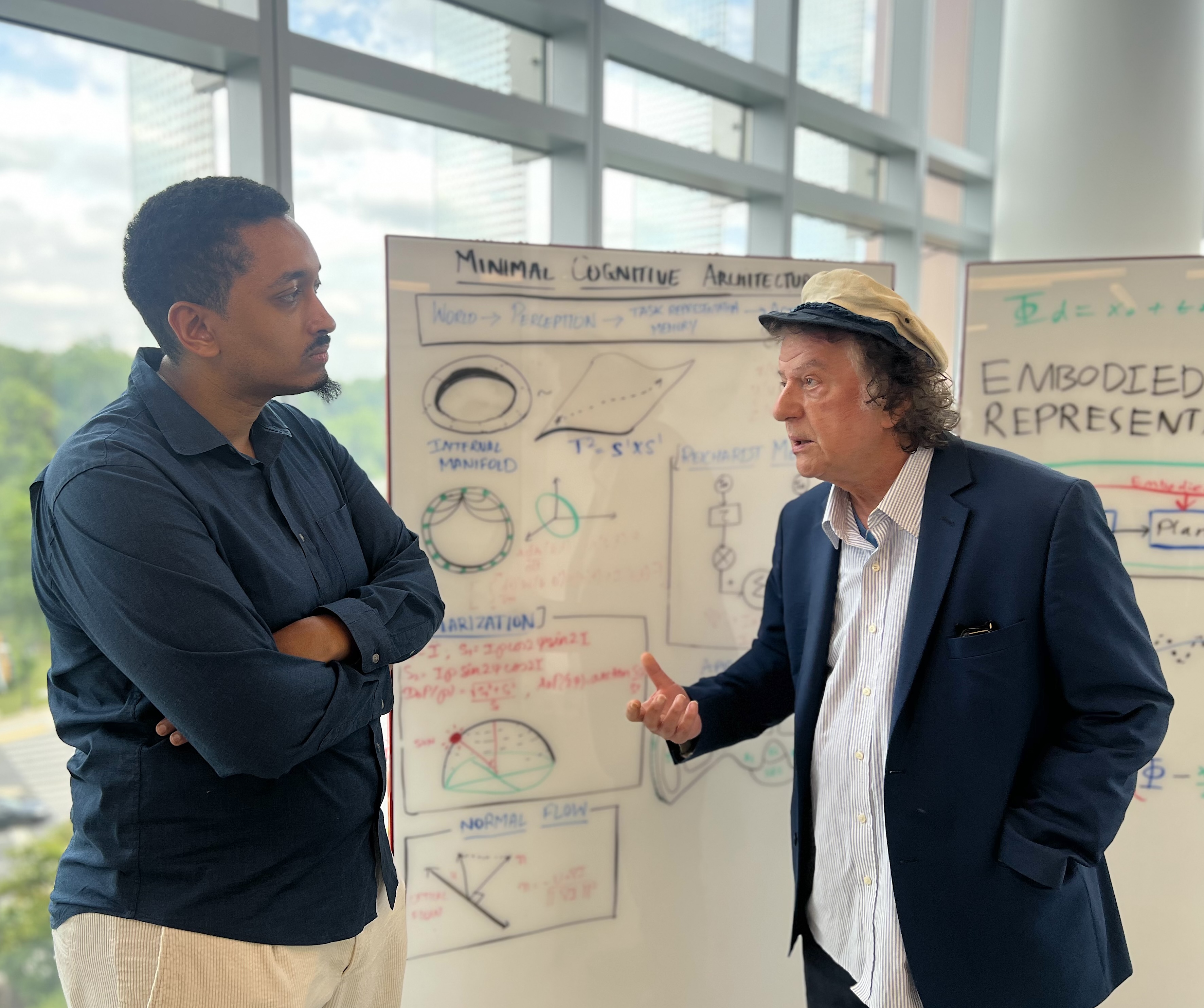
While modern video models can often recognize broad activities, they frequently struggle to understand the lower-level hand movements, action primitives and physical forces exchanged during object manipulation. Dessalene's project seeks to bridge that gap by building AI systems that can learn structured hierarchies of action from both visual and physiological data, developing higher-level understanding from these low-level sub-actions.
His research will combine egocentric, or first-person, video with electromyography (EMG) data collected from wrist-worn sensors. EMG measures the electrical activity produced by muscles, providing critical information about hand movements, contact and force that may be invisible in video alone.
By pairing video with EMG signals, Dessalene is training deep learning models to essentially “see the forces” exchanged between hands and objects. The approach could help AI systems develop a more physically grounded understanding of human actions, moving beyond visual observation alone.
“Eadom’s research tackles one of the most fundamental abilities of the human cognitive system—how we learn by watching others,” Aloimonos said. “What sets his work apart is the way it combines visual information with signals from the body itself. By capturing muscle activation alongside video, he is creating a technology with applications spanning healthcare, education, defense and robotics.”
The fellowship builds on Dessalene's doctoral research in robot learning, embodied AI, egocentric vision and multimodal perception. His previous work explored how robots can learn from human videos and how physical interaction can improve visual representations of actions and objects.
In one project, Dessalene helped develop a large-scale dataset that paired first-person video with force measurements collected during natural object manipulation tasks, creating new opportunities for researchers to study the relationship between visual observations and physical interactions.
“Humans learn an enormous amount simply by observing others and interacting with the world,” Dessalene said. “My goal is to help AI systems move beyond recognizing what someone appears to be doing and toward understanding how they are physically engaging with their environment. That kind of understanding could have important applications in robotics, assistive technologies and augmented reality.”
A Shared Foundation
While Burner and Dessalene are pursuing different scientific questions, both trace their research roots to the Perception and Robotics Group's emphasis on machine perception and embodied intelligence.
Their fellowship projects—one focused on understanding atmospheric turbulence and the other on understanding human action—reflect a shared goal of helping machines better understand the physical world.
Their selection for the IC Postdoctoral Research Fellowship highlights the impact of that research environment and underscores the growing role of UMD researchers in advancing AI, robotics, sensing and machine learning in areas of national importance.
—Story by Melissa Brachfeld, communications group