
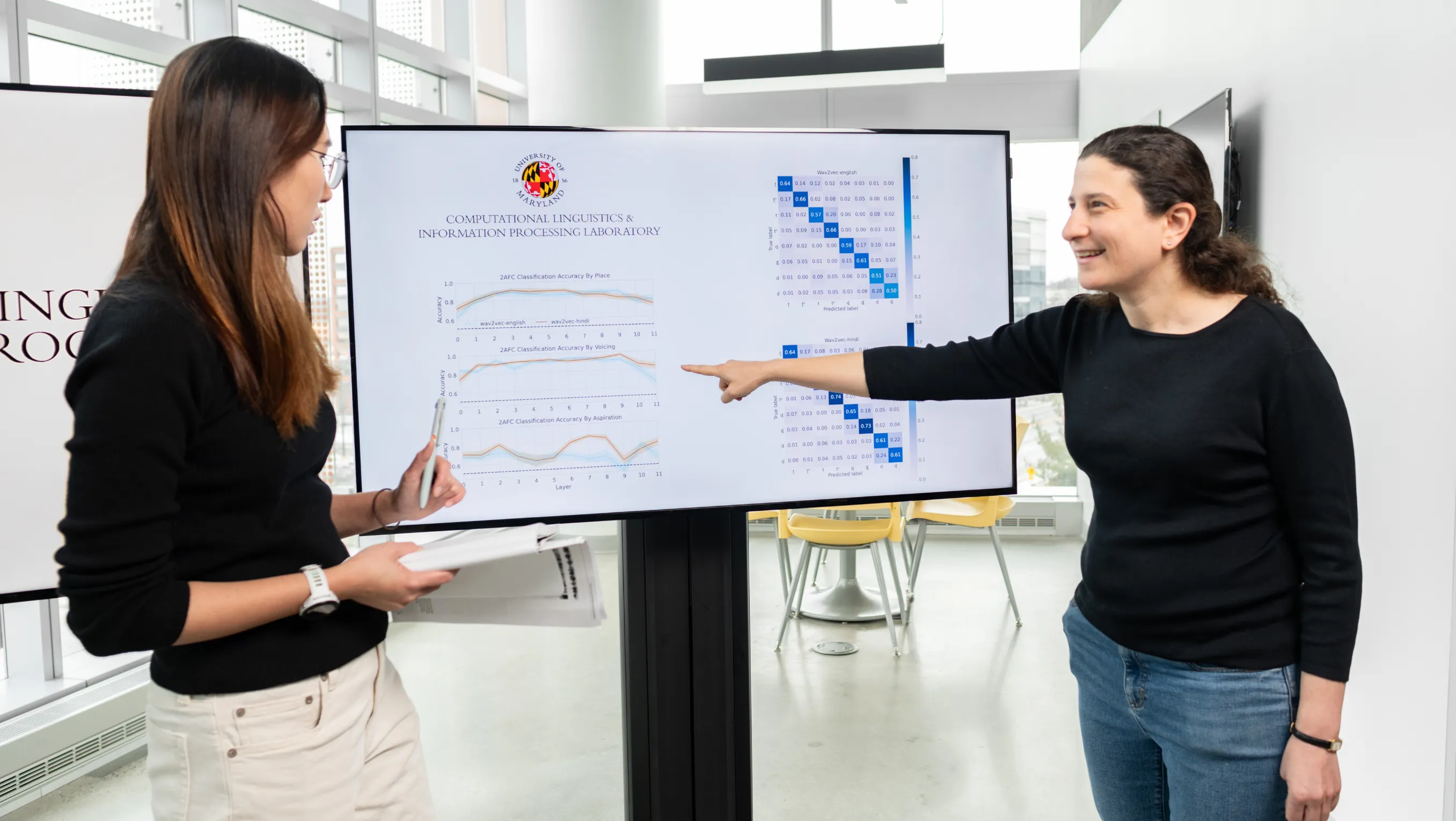
As artificial intelligence systems become increasingly powerful, a University of Maryland researcher is leading an international effort to bring language scientists and AI researchers together around a shared goal: building technologies that better reflect how humans learn and use language.
Naomi Feldman, a professor of linguistics and researcher with the University of Maryland Institute for Advanced Computer Studies (UMIACS), is spearheading a first-of-its-kind partnership between two major research communities whose work is shaping the future of AI.
On July 3–4, 2026, the Society for Computation in Linguistics (SCiL) will hold its ninth annual meeting as a workshop co-located with the Annual Meeting of the Association for Computational Linguistics (ACL 2026), the world's premier conference for language-focused artificial intelligence research. The gathering in San Diego marks the first time the organizations have formally joined forces, creating new opportunities for collaboration between researchers studying human language and those developing AI technologies.
Feldman organized the initiative alongside Tal Linzen of New York University and Rob Voigt of the University of California, Davis.
The effort comes at a pivotal moment for artificial intelligence. While today's large language models can generate remarkably human-like text, many researchers believe future advances will require a better understanding of how people acquire language naturally—a question that has long been at the heart of linguistics research.
Insights from human language learning could help create AI systems that learn more efficiently, require less training data and perform better across a wider range of languages. The same interdisciplinary work could also yield new tools for studying language disorders and improving second-language education.
"Intellectual exchange between these communities has been critical for ensuring that language technologies take advantage of scientific advances," Feldman said. "By bringing these events together, we can stimulate direct interaction and foster collaborations that might not otherwise happen."
The initiative reflects a longstanding strength at Maryland, where collaboration across disciplines has helped establish the university as a leader in language science and artificial intelligence. Feldman is a core member and former director of UMD's Computational Linguistics and Information Processing (CLIP) Lab, where researchers develop algorithms and methods that enable computers to perform language-related tasks while also using computational approaches to better understand the human capacity for language. The lab's work spans linguistics, computer science and cognitive science and includes exploring large, complex datasets at scale.
To broaden participation, Feldman and her colleagues secured a $39,000 grant from the National Science Foundation to fund "crossover" scholarships that will help SCiL presenters attend the larger ACL conference. The funding is intended to reduce financial barriers that often prevent linguists—particularly students—from participating in major AI-focused conferences.
Because linguistics departments typically have fewer resources than computer science programs, Feldman said the scholarships are essential for ensuring that language scientists have a seat at the table as AI technologies continue to evolve.
Among the scholarship recipients is Annika Shankwitz, a first-year doctoral student in linguistics and member of the CLIP Lab, who will represent UMD at the workshop. She will present research examining how speakers of one language perceive sounds from a second language.
The workshop's keynote speakers include Jennifer Hu, an assistant professor of cognitive science at Johns Hopkins University, and Noah Smith, vice provost for artificial intelligence at the University of Washington and one of the field's leading AI researchers. In addition, Philip Resnik, a professor of linguistics at UMD and longtime member of CLIP, will deliver a keynote address at the ACL main conference.
For Feldman, the success of the SCiL workshop will ultimately be measured by the connections it creates and the perspectives participants carry forward into the next generation of AI research.
"By providing these educational opportunities, we are helping linguistics students bring a unique, scientific perspective into the tech industry," she said. "Ultimately, this effort is about more than just better code—it's a major step toward building AI that is grounded in the reality of how humans actually communicate."
—Story by Melissa Brachfeld, UMIACS communications group