 |
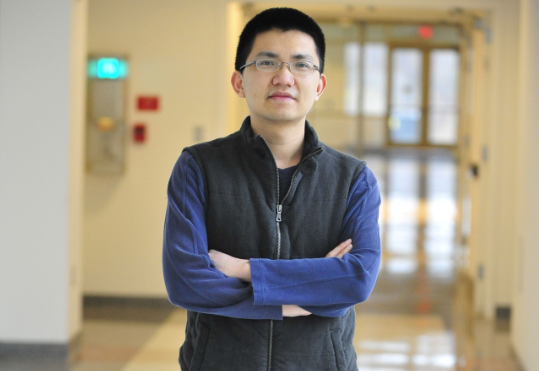
Currently I am a Scientist in Raytheon BBN Technologies. Before coming to BBN, I worked as a researcher in Huawei Technologies in Hong Kong from 2013~2014. From 2011~2012, I was an Assistant Research Scientist in the Computer Vision Lab at University of Maryland, College Park, where I was working with Prof. Larry S. Davis. My research interest includes computer vision and machine learning, specifically on sparse coding, dictionary learning, submodular optimization, supervised and unsupervised clustering, and transfer learning. Email: zhuolinumd@gmail.com [Publications | Citations | Research | Resources | Resume] |
News:
- The source code for submodular reranking for retrieval is released now! [project page]
- One paper is accepted by NIPS 2014
- One paper is accepted by ACCV 2014 as an oral paper
- One paper is accepted by CVPR 2014
- The source code for incremental dictionary learning is released now! [project page]
- One paper is accepted by WACV 2014
- One paper is accepted by ICCV 2013
- One paper is accepted by BMVC 2013
- The source code for submodular dictionary learning is released now! [project page]
- One paper is accepted by TPAMI
- Three papers are accepted by CVPR 2013
- Our paper won the Best Student Paper Award at the ACCV 2012 conference
- Two papers are accepted by ACCV 2012 (one oral, one poster)
- The source code for MMI is released now! [project page]
- The source code for LC-KSVD is released now! [project page]
- Journal Reviewer
- IEEE Transactions on Pattern Analysis and Machine Intelligence
- IEEE Transactions on Circuits and Systems for Video Technology
- IEEE Transactions on Neural Networks and Learning Systems
- IEEE Transactions on Multimedia
- IEEE Transactions on Image Processing
- IEEE Transactions on Information Forensics and Security
- IEEE Transactions on Cybernetics
- ACM Transactions on Intelligent Systems and Technology
- International Journal of Computer Vision
- Computer Vision and Image Understanding
- Image and Vision Computing
- Pattern Recognition
- Program Committee
- Vision: CVPR 2011/2013/2014/2015, ECCV 2012/2014, ICCV 2013/2015
- PR/ML/AI/Graphics: ACPR 2015, ACML 2013, IJCAI 2015, Eurographics 2015
- Guest Editor
- Pattern Recognition Special Issue on Discriminative Feature Learning from Big Data for Visual Recognition
- CCF Young Computer Scientists & Engineers Forum, Guangzhou, 12/2014
- Symposium on Mobile Graphics and Interactive Applications at SIGGRAPH Asia, Shenzhen, 12/2014
- Nanyang Technological University, Singapore, 11/2014
- The University of Hong Kong, Hong Kong, 10/2014
- The Hong Kong Polytechnic University, Hong Kong, 01/2013
- The Hong Kong University of Science and Technology, Hong Kong, 01/2013
- The Chinese University of Hong Kong, Hong Kong, 01/2013
- University of Maryland, College Park, USA, 07/2011
- Panasonic Research, New Jersey, USA, 06/2011