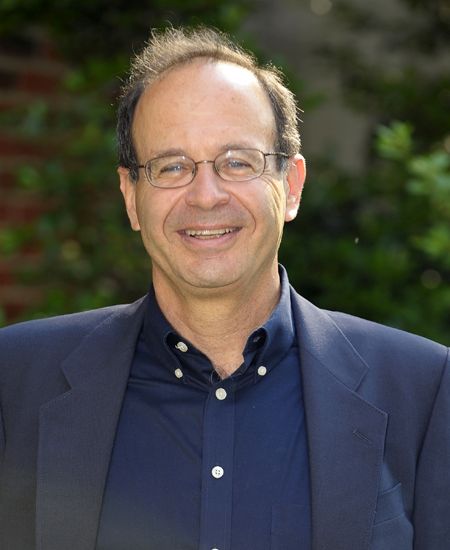
Uzi Vishkin
Education
- D.Sc., Computer Science, Technion - Israel Institute of Technology (Haifa, Israel), 1981
- M.Sc., Mathematics, Hebrew University (Jerusalem, Israel), 1975
- B.Sc., Mathematics, Hebrew University (Jerusalem, Israel), 1974
Organization
Top |
Bio |
Research Interests |
Publications |
Reseach Project |
Software Release |
On-Line Tutorial |
Conf. Organization |
Talks |
Teaching |
Contact
Research Interests
Non-technical introduction
Overview and 2019 Perspective: Uzi Vishkin's research aspirations evolved over the years from that of a parallel algorithms theory specialist to more of a generalist. The deep question guiding his work has been whether it is feasible to align the theory of parallel algorithms, parallel programming and many-core hardware into a coherent computing stack for the processor of the future. Along with his research team, he developed the only current approach that enables that, while vendor-supported approaches have given up on their prior objective, as explained next.
Source programming (coding) is the programmer's input towards an executable program on target hardware. It is widely agreed that executables on many-core hardware must be multi-threaded. However, multi-threaded source programming is often too difficult, due to challenges such as race conditions and programming for locality. By 2019, (CPU and GPU) commercial vendors have apparently nearly abandoned all their prior expectations that application developers provide multi-threaded source code. To the extent that new performance executable are produced they are developed by in-house vendor programmers, often for the few specific routines that their marketing people identified as useful, e.g., for Python programmers.
In contrast, Vishkin's team has demonstrated that single-threaded programming for parallelism can: (i) directly harness the theory of parallel algorithms as-is for parallel programming, and (ii) achieve competitive many-core performance, as long as many-core hardware/software has been designed properly.
Still, a listing of technical areas and some elaboration follow:
- Parallelism in computing
- Design and analysis of algorithms.
- Synergy of algorithms, programming and architecture for an easy-to-program general-purpose parallel computer platform.
The premise that inspired his work in the last few years on the PRAM-On-Chip
framework has been: Were the architecture component of PRAM-On-Chip feasible in the 1990s, its parallel programming component would have become the mainstream standard.
In 1979 Uzi Vishkin identified the combined issue of parallel algorithms, parallel algorithmic thinking and programmability as the most critical
component in developing a successful general-purpose parallel computer architecture. It simply did not look practical to proceed with building parallel computers before establishing a first satisfactory draft of its specifications.
Such specifications had to include how to think about programming the computer to be built.
Many, including Uzi Vishkin, spent the next 15-20 years on parallel algorithmics. In fact, during the 1980s and the early 1990s, quite a few very talented computer science researchers worked on the following wider problem: Seek the "ultimate" parallel programming model that will allow easy expression of parallel algorithms and their programs in the model, as well as validation of the model by algorithmic paradigms and solutions for as many problems as possible. In this fierce "battle of ideas", the one approach that has beaten all its competitors by a truly wide margin was the PRAM approach. As early as 1988, standard algorithms textbooks started including significant chapters on PRAM algorithms, and as the above premise suggests, PRAM algorithms were on their way to become standard computer science know-how that every computer science graduate must command and the basis for standard parallel programming. However, multi-chip multi-processing architectures provided the only form of multi-processing available in the 1990s. They required high coordination overhead, which prevented PRAM algorithms from providing an effective abstraction for them. As a result, it became common wisdom that "PRAM algorithms are unrealistic", leading later editions of some textbooks to remove their PRAM chapters.
The good news are that the PRAM-On-Chip effort is finally establishing that it is becoming feasible to build a parallel computer that can be effectively
programmed by a PRAM-like language.
From today's perspective, the prospects for making the PRAM approach a standard for parallel algorithms and programming look pretty good: (i) "Darwin has already spoken" - see the
natural selection that already happened in what was called above the battle
of ideas; (ii) The inclusion of significant PRAM chapters
in standard textbooks, before concerns about implementability prevailed; but (iii)
These concerns are becoming less and less relevant as the PRAM-On-Chip project, with its extensive hardware prototyping, continues its
progress.
The optimistic tone above should not hide the fact that a significant research effort is still underway.
- Machine learning as well as other potential "killer applications" for parallel computing.
- Pattern matching.
- Theory of computing. In fact, the theory-driven PRAM-On-Chip
effort aspires to provide a nice example where a forward looking
theory-driven approach has practical impact.
Top |
Bio |
Research Interests |
Publications |
Reseach Project |
Software Release |
On-Line Tutorial |
Conf. Organization |
Talks |
Teaching |
Contact
Publications
Research Project
Software Release
Tutorial
-
On-Line Tutorial
. Our recent public software release
allows you to use your computer for programming on an XMT environment
Top |
Bio |
Research Interests |
Publications |
Reseach Project |
Software Release |
On-Line Tutorial |
Conf. Organization |
Talks |
Teaching |
Contact
Conference Organization
- Organizer, Workshop on Theory and Many-Cores (T&MC): What Does Theory Have to Say About Many-Core Computing? to be held at the University of
Maryland, May 29, 2009.
-
Organizer, Workshop on Parallelism in Algorithms and Architecture, May 12, 2006
- Program Chair, ACM SPAA 2006
From the scope statement for SPAA 2006:
A renaissance of parallel computing research is on the horizon since:
(i) chip multi-cores are the wave of the future for all major hardware vendors,
(ii) since 2003 clock frequency of CPUs is hardly advancing any more,
(iii) the 6-decade quest for an easy-to-program parallel architecture paradigm
is yet to provide a competitive alternative to the serial paradigm.
Contributed papers on algorithmics, software and/or hardware that address this
emerging renaissance are particularly welcome for SPAA 2006.
- For more talks see the PRAM-On-Chip home page
Teaching
[
This is a link to suggestions on teaching parallelism as a theory-type algorithms course coupled with
programming assignments.
We provide all the material needed for a course on parallel algorithms coupled with XMTC programming assignments:
video-recorded lectures for the full semester,
class notes, dry homework assignments, and
programming assignments along with a complete software environment, based on our recent public software release. It
allows students to use their private computers for programming on an XMT environment.
Lance Fortnow's
recent blog postings The
Revenge of Parallelism and
Teaching Parallelism
provide a helpful discussion thread.
]
Interesting Teaching-Related Links
- Explaining parallel computing at Middle School:
What Grown-Ups Do Not Understand About Parallel Programming -
The Peanut Butter and Jelly Story.
-
2012-2015: Synthesis of Parallel Algorithms (in Greek), University of Cyprus.
You cannot imagine the satisfaction a person gets, after designing and analyzing algorithms on
PRAM for more than 12 years, to finally be able to tell to students...
"this can be easily turn to code and run on a real-world multi-core machine"!!!--Prof. Chryssis
Georgiou on using the XMT platform in his University of Cyprus class.
-
2012-2016: Parallel Computing Architectures, Electrical Engineering, Technion, Israel-Institute-of-Technology.
-
Spring 2011: Parallel Algorithms, University of California, Davis.
-
Spring 2011: Parallel Algorithms, University of California, San Diego.
-
Registration form for Middle School Computer Engineering Summer Camp at the John F. Kennedy High School,
Silver Spring, Maryland, July 13-24, 2009, Montgomery County Public Schools:
"Students will learn about computer programs for the 64-processor desktop-of-the-future computer built
at UMCP and will explore relevant Computer Science and Mathematics concepts".
-
2009-10: Parallel Computing , Thomas Jefferson High School for Science and Technology, Alexandria, VA.
Chapter on Explicit Multi-Threading (XMT) from 2008-9 course.
-
"Parallel Programming Comes to Ingenuity", The Ingenuity Spotlight, February 2009, The Ingenuity Project at the Baltimore Polytechnic Institute
High School.
Note the following comment in the story on page 2: ''The three classes in December were part of a study performed by UMCP
Department of Computer Science to test these new teaching methods, and it turned out to be successful: in the questionnaires filled out
by the students there was an equal split between people who said the material was the right level of difficulty and people who said
it was too easy.'' (Bold face added, UV.)
-
Spring 2009: Algorithms and Programming in a Parallel Environment (syllabus in Hebrew) , The Academic College of Tel-Aviv Yaffo.
-
Resources for multicore programming education , webpage maintained by Nir Shavit, Tel Aviv University.
Personal Links
Statement Against Boycott
Where is the outrage over the bombardment of civilians in Israel?
- Mailing Address:
- Uzi Vishkin
- University of Maryland Institute for Advanced Computer Studies (UMIACS)
- A.V. Williams Building. Room 2365
- College Park, MD 20742-3251
- Phone: (301) 405-6763
- email: x at umd.edu, where x is the last name
Top |
Bio |
Research Interests |
Publications |
Reseach Project |
Software Release |
On-Line Tutorial |
Conf. Organization |
Talks |
Teaching |
Contact
|